Shop
From time to time, selected items from the TC are made available as part of the ongoing development and refinement of the meta-collection. These may include duplicate objects, as well as items that no longer fulfil a defined role within the TC or are no longer aligned with its evolving direction.
For further details and the current price list, please contact us.
Art Collections
- D’ALLEMAGNE, Henry-René (1948), La maison d’un vieux collectionneur. Paris: Librairie Gründ. 2 volumes, comprising one text volume (304 pp., 14 plates) and one plate volume (separate leaves, housed in the original folder box), with approximately 253 plates. A special copy of this celebrated work, one of only 150 copies reserved for the collaborators, family, and friends of the author, here belonging to Maurice Protat, whose name is printed in the volume. In addition to the author's detailed description of his house and collection, the first volume contains an original essay on the history of collecting over the centuries, making the work of particular interest for the history of collecting and the culture of the cabinet de curiosités. The copy is accompanied by a highly informative typed letter, dated 31 December 1947, from Henry-René D'Allemagne to his editor, Mr Gründ, written shortly before publication. In the letter, D’Allemagne provides detailed information about the production and distribution of the book, including the planned print run of 600 copies, of which 400 were intended for the publisher and 200 for the author (although the author ultimately received 150 copies). D’Allemagne also describes the contents of the two volumes: the first devoted to a description of his house and a history of collecting, and the second intended to contain 265 photographic plates. He concludes by detailing the expenses incurred in the production of the work, amounting to 430,000 francs.
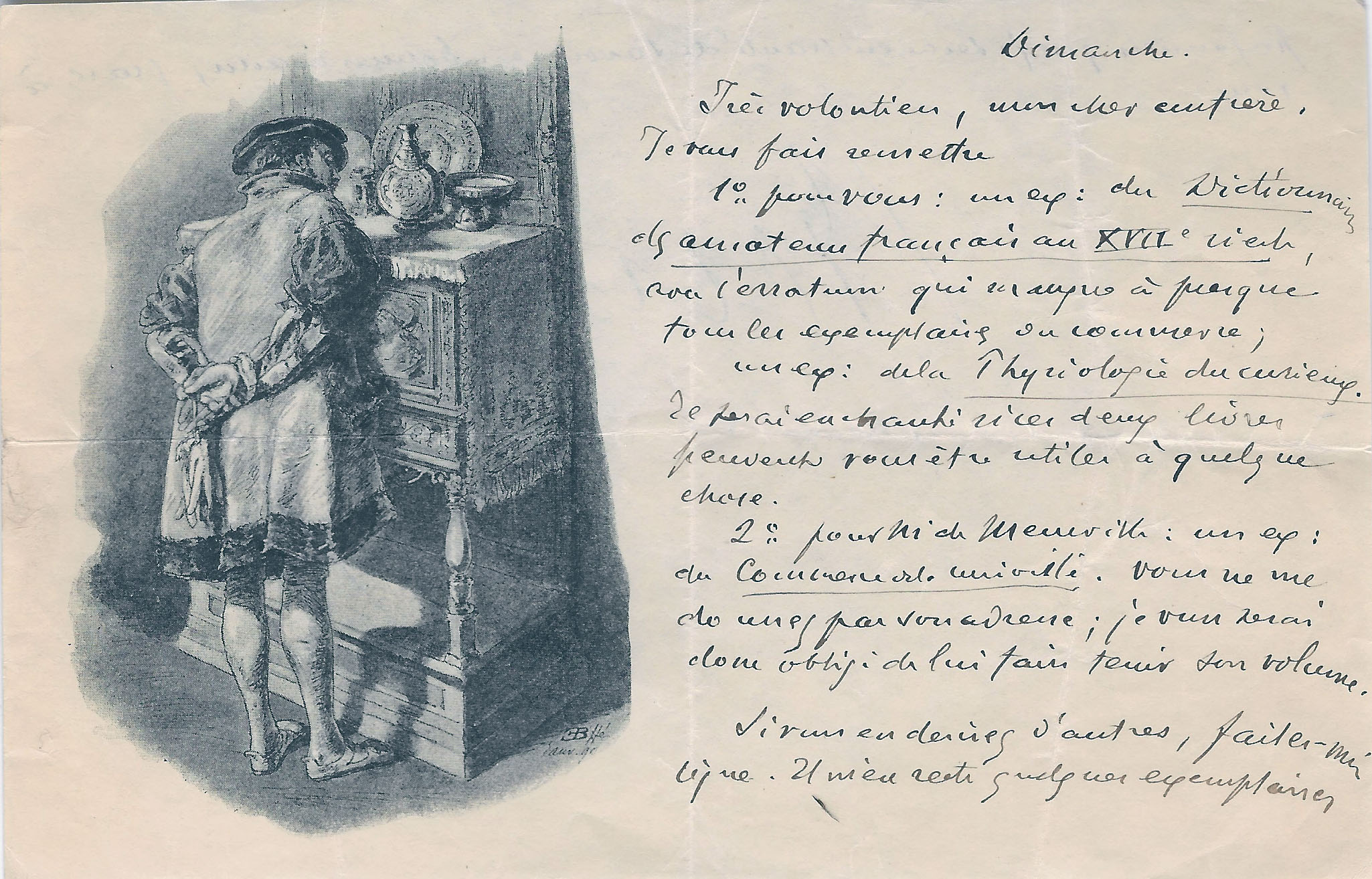
- Bonnaffé, Edmond: Undated manuscript letter, about sending copies of several of his books. Illustration depicting Bonnaffé investigating some ceramics [page 1, page 2]
- Champfleury: CHAMPFLEURY (1877), Le Violon de Faïence. Paris: E. Dentu, 173 pp., 34 etching prints by Adeline incl. the faience violin in frontispiece. In-8, half blue morocco binding with corners, spine with five raised bands adorned with gilt stippling, compartments bordered with a triple gilt fillet and decorated with small tools, gilt title, gilt fillet on the covers, gilt top edge, covers preserved. Signed Mercier, ss. de Cuzin, housed in a slipcase (showing some wear). Includes two artist's proofs of the faience violin, signed by Adeline.
- Gouellain, Gustave: GOUELLAIN, G. (1872), L'Assiette dite A La Guillotine. Paris: Jouaust, 44 pp., incl. coloured plate depicting the famous Assiette à la Guillotine. Twentieth-century binding with gilt spine decoration, hard stamp from a Madrid library, one of 250 copies (one of 200 on tinted paper with black ink) – The scarce notice on the famous faience plate depicting a guillotine with interesting sections on political (sometimes hidden) messages on plates, revolutionary ceramic, the Assiette à la Guillotine, controversy, and anecdotes & myths.
- Louvre: Rare depiction by Gabriel Jacques de Saint-Aubin of one of the biennial exhibitions of contemporary art in the Louvre's Salon Carré, here a photogravure made by Charles Amand Durand - Charles Amand Durand (1831-1905) was famous for resurrecting the fading copper & wood plates of previous painters. Engravings and etchings by Gabriel Jacques de Saint-Aubin (1724-1780) form a valuable record of the Parisian artistic life in the 18th century. Dimensions: 27.5 x 19 cm (sheet), 15 x 12 cm (image), believed to be from the period 1869-1880's.
Book Collections
- Dibdin, Thomas Frognall: DIBDIN, T.F. (1842), Bibliomania; Or, Book-Madness; a Bibliographical Romance. Illustrated with cuts... New and Improved edition, to which are now added, Preliminary Observations, and a Supplement, including a Key to the Assumed Characters in the Drama. London: Bohn. Tall thick 8vo, (2), [i-vii], vii-xiv, 618, 63, (1), xxxiii pp. Full pebbled brown morocco (some rubbing) with gilt fillet borders, gilt turn-ins, gilt-panelled backstrip, raised bands, gilt top, rebacked retaining original backstrip. Bookplate on front pastedown of Francis Frederick Fox and Charles Sebag-Montefiore. Some moderate foxing on some pages, more significant in the first few pages. First combined edition, large paper copy. The book that introduced the concept of bibliomania to the world. 500 copies were printed, of which 50 (according to Huth) or 55 (according to Church) were large-paper ($2000 value penned by a dealer expert in Dibdin).
- Hobons, Anthony: HOBSON, A. (1975), Apollo and Pegasus: an enquiry into the formation. Amsterdam: Gérard Th. Van Heusden. Edition limited to 652 numbered copies, of which this is one of 32 not for sale, no. XVII, signed by author below colophon. No dust jacket. Further inscribed by author: "To Alan Bell, fellow-student of biographical and bibliographical problems from his friend. Anthony Hobson". With some ephemera loosely inserted.
- Hobons, Anthony: HOBSON, A. (1990), Humanists and bookbinders : the origins and diffusion of the humanistic bookbinding 1459-1559, with a census of historiated plaquette and medallion bindings of the Renaissance. Cambridge University Press. Inscribed by author: "Michael, with best thanks from Anthony 11.I.90". With ephemera loosely inserted.
- SPENCER, A.H. (1959), The Hill of Content. Books, Art, Music, People. Sydney: Angus and Robertson. Original boards in dust-wrappers - The reminiscences and reflections of one of Australia's leading booksellers of the first half of the 20th century. Inscribed: "To laugh heartily, To pray fervently, To love devotedly A.H. Spencer", "Warm friends, friendly books, ease the way of the world". Some wear to the dust jacket.
Varia
- Sotheby's:
Art Collections
PIGAGE and DE MECHEL (1778), La Galerie électorale de Dusseldorff, ou catalogue raisonné et figuré de ses tableaux, unsophisticated 2-volume copy in original boards. Accompanied by the study by GAEHTGENS and MARCHESANO (2011)
"Princely representation in the baroque period no longer meant simply displaying a wide variety of artistic treasures [...] Following the age of housing mirabilia—art objects and curiosities—in seventeenth-century Wunderkammern, some princes attempted to order their treasures according to systematic, if not scientific, criteria. Johann Wilhelm II and his successors [...] were among those baroque rulers who combined their passion for collecting with an interest in employing the expertise of connoisseurs. These princes established a paradigm, which was emblematic of the transition from the baroque to the Enlightenment."
Gaehtgens & Marchesano, The Düsseldorf Gallery and Its Catalogue, 2011:1
_Dusseldorf(catal1778)_thumbnail.jpg)
Fig. 1. Zoom into one of the thumbnail etchings of Plate I (see below). The work of the engravers was extraordinarily laborious and could only be carried out with magnifying glasses (Gaehtgens & Marchesano, 2011:29).
La Galerie Électorale de Dusseldorff ou Catalogue raisonné et figuré de ses tableaux (1778) occupies a foundational position in the history of art collecting. The collection, created by the elector Palatine Johann Wilhelm II von der Pfalz (1658-1716), comprised around four hundred paintings, forty-six of which were by Rubens. It was his father who had inspired a passion for art in him and his second wife, Anna Maria Luisa de' Medici (last direct descendant of the House of Medici), who provided him the best connections for acquiring Italian masterpieces. The gallery occupied a purpose-built structure erected between 1709 and 1714, directly adjacent to the Düsseldorf palace, clearly expressing the elector's intention to establish an autonomous space in which artworks could be presented to visitors in a systematic arrangement. However, it was only well after his death, following the temporary relocation of the collection to safeguard it during the Seven Years' War (1756-63), that a new display system was implemented upon its reinstallation, a development visually documented in the 1778 catalogue. Through the changes made by the director of the collection, the painter Lambert Krahe (1712-90), serving under elector Carl Theodor von der Pfalz, Johann Wilhelm's nephew and successor, the gallery embodied a new concept of display, based on the different schools of painting and on "the modern approach of not hanging the paintings frame to frame, but rather allowing them to preserve their identity as works of art in the space" (Gaehtgens & Marchesano, 2011:31). The 1778 catalogue documents these innovations thanks to its miniature reproductions of paintings (Fig. 1), which consistutes in itself a radical departure from the large prints that characterised previous art collection albums.
- GAEHTGENS, Thomas W., MARCHESANO, Louis (2011), The Düsseldorf Gallery and Its Catalogue. Display & Art History, The Getty Research Institute, 95 pp. [in coll.: Softcover, as issued]
A Copy in its Original Publisher's Binding of the First Modern Art Collection Catalogue
_Dusseldorf(catal1778)_firstwallfirstroom.jpg)
_Dusseldorf(catal1778)_binding.jpg)
_Dusseldorf(catal1778)_titlepage.jpg)
_Dusseldorf(catal1778)_building.jpg)
La Galerie électorale de Dusseldorff, ou catalogue raisonné et figuré...
Basel, 1778
Description: PIGAGE, Nicolas (author), DE MECHEL, Chrétien (engraver) (1778), La Galerie électorale de Dusseldorff, ou catalogue raisonné et figuré de ses tableaux [followed by] Estampes du catalogue raisonné et figuré des tableaux de la Galerie Électorale de Dusseldorf. Basel, Text volume: XIV, [2], 34, [2], 28, [2], 52, [2], 42, [2], 28, [2], 44 pp. Plate volume: title-page + 40 plates (A-D + I-XXXVI). Unsophisticated copy in two volumes. Large oblong folio (40 x 31 cm) in publisher's boards (with some wear and minor stains), untrimmed, with large margins on extremely fine laid paper - This is the catalogue of one of the most significant European picture galleries of the 18th century, created by the Elector Palatine Johann Wilhelm II and later rearranged, under his successor Carl Theodor, by the collection's director, Lambert Krahe. Produced by court architect Nicolas de Pigage (1723-96) with the help of the engraver Christian von Mechel (1737-1817), the first volume is a catalogue text (composed by Jean-Charles Laveaux, 1749-1827) where paintings are described with all their technical data and extensive commentaries. This work is strikingly modern in being both comprehensive and accessible to an educated public, thereby establishing itself as an art-historical reference work (Gaehtgens & Marchesano, 2011:36). The second volume presents a set of forty plates depicting the gallery and its paintings. Individual pictures can be identified, especially as their frames are labeled with the names of the painters and catalogue numbers. Although the paintings had different frames, they were standardised in the engravings to achieve a harmonious and unified appearance. Through the illustrations in Pigage and Mechel's catalogue, one can envisage a tour of the rooms in the second half of the 18th century and analyse the criteria used for arranging the works of art in this gallery (ibid.:19). Indeed, the virtual visitor first encounters the gallery's floor plan and the elevation of the gallery building, which serve as a preparatory guide. He then ascends a staircase adorned with allegorical decorations to reach the second floor, comprising five rooms dedicated to paintings. "When we view the volume of engravings from our vantage point today and consider it to be a revolutionary innovation, it is because we judge it retrospectively, in light of the history of the museum in the nineteenth and twentieth centuries and our familiarity with museum publications in which small, thumbnail-size illustrations continue to be used for identifying the individual works and not for studying them" (ibid.:30).
Select a thumbnail to view its caption.
Book Collections
J.K. Rowling (1997), Harry Potter and the Philosopher's Stone, 13th UK printing, inscribed in 1998 by Rowling.
The Harry Potter saga by J. K. Rowling stands as the publishing phenomenon of the turn of the 21st century. Few works of modern literature have achieved comparable global reach, cultural impact, or commercial success. It is unsurprising that rare Harry Potter material, such as first editions, their early printings, manuscripts, and associated ephemera, has entered major collections. Chief among these is the first edition of Harry Potter and the Philosopher's Stone, published by Bloomsbury in 1997. The first printing of the hardback edition, limited to just 500 copies (of which roughly 300 were sent to libraries), has become the definitive modern collectible; even severely worn ex-library copies command extraordinary sums. The corresponding first-edition first-printing paperback, produced in a larger printing of approximately 5,150 copies, is likewise coveted as the earliest widely circulated form of the text. Both can reach stratospheric prices, with association copies at the very top of the market. Later printings remain desirable when they bear early signatures or substantial inscriptions by Rowling, written before she achieved global celebrity. Such copies capture a moment when the author's fame was still local and literary rather than universal, and they function as documentary artifacts of the series' nascent years.
Early Inscribed Copy of Harry Potter and the Philosopher's Stone Documenting the Birth of a Global Literary Phenomenon
_HarryPotter(HP1_inscribed2Kathleen).jpg)
Harry Potter and the Philosopher's Stone, by J.K. Rowling
London, UK: Bloomsbury, 1997 (paperback ed.)
Description: Thirteenth printing, paperback. An exceptionally fine, unread copy bearing a particularly scarce summer 1998 signature variation together with an unusually long, highly personal inscription: "To Kathleen – Thank you for liking book two even better (that's the one I'm worried about at the moment! JK Rowling)". Signed at the recipient Kathleen's workplace, the book remained in her possession until 2024. The inscription captures Rowling at a uniquely early stage of her career, shortly after the publication of Harry Potter and the Chamber of Secrets. At this point she was still accessible to readers, often taking time to write lengthy, conversational inscriptions that would become increasingly uncommon as her international fame accelerated. Her candid aside about worrying over the reception of the second book offers a rare glimpse into the uncertainty of an author who had not yet become one of the world's most celebrated writers. Preserved in a custom-made quarter-leather red clamshell box with bespoke gilt lettering and accompanied by a CoA by Adam Houston.
Select a thumbnail to view its caption.
CUMBERLAND (1787), An accurate and descriptive catalogue of the several paintings in the King of Spain's palace at Madrid... from 'Beckford's Folly' Library
William Thomas Beckford (1760-1844), who inherited a colossal fortune from transatlantic slavery, was a novelist, art collector and bibliophile. The legendary setting of his collections, Fonthill Abbey, his dream house, is perhaps better known than the collections themselves, or at least contributed to their elevation. Known as Beckford's Folly, it was an enormous country house built in the Gothic revival style between 1796 and 1813. Once completed, Beckford lived in near-total seclusion, enjoying both the splendour of the building and his vast treasures alone. He had effectively exiled himself from British society following a scandal, and was later widowed when his wife died in Switzerland while giving birth to their second child. During this continental exile, Beckford had seized the opportunity to acquire the Lausanne library of Edward Gibbon, forming the foundation of his own library, which would grow to an extraordinary scale. By 1822, however, mounting debts forced him to put Fonthill Abbey up for sale. An illustrated catalogue was prepared by Christie's, and the pre-sale viewing drew such crowds from London that every farmhouse in the surrounding area was filled with visitors. Before the auction could take place, Fonthill, along with part of its contents, was sold to John Farquhar, a millionaire dealer in gunpowder. Farquhar promptly auctioned the art and furnishings in the famous Fonthill sale of 1823. The Fonthill sale event was vividly recorded by William Hazlitt in Sketches of the Picture Galleries of England: "FONTHILL ABBEY, after being enveloped in impenetrable mystery for a length of years, has been unexpectedly thrown open to the vulgar gaze, and has lost none of its reputation for magnificence – though, perhaps, its visionary glory, its classic renown, have vanished from the public mind for ever. It is, in a word, a desert of magnificence, a glittering waste of laborious idleness, a cathedral turned into a toy-shop, an immense Museum of all that is most curious and costly..." Adding to its legend, the central tower of Fonthill collapsed in 1825. Farquhar sold what he could and died six months later of apoplexy. Beckford, a compulsive collector, had repurchased many of his former possessions during the 1823 sale, often at prices lower than those he had originally paid, assisted by his son-in-law, the Duke of Hamilton. This effectively constituted a second collection, which Beckford developed and housed at Lansdown Tower in Bath, yet another architectural folly known as Beckford's Tower. His enduring passion for books is attested by letters written to his bookseller, George Clarke, between 1830 and 1834 (Gemmett, 2000). This second collection was inherited by his younger daughter, Susan Euphemia Beckford, wife of Alexander Hamilton, 10th Duke of Hamilton. The books and most important treasures were transferred to Hamilton Palace. The collection was ultimately dispersed in the Hamilton Palace sale of 1882, one of the major auctions of the century, with the library sold by Sotheby's in 1883.
A Rare 1787 Art Collection Notice from 'Beckford's Folly' Library, in Precious Kalthoeber Binding, sold at the 1823 Auction
.jpg)
Catalogue of the several paintings in the King of Spain's palace at Madrid
London: printed for C. Dilly, in the Poultry and J. Walter, Charing-Cross, 1787
Description: Cumberland, Richard (1787), An accurate and descriptive catalogue of the several paintings in the King of Spain's palace at Madrid; with some account of the pictures in the Buen-Retiro. London: printed for C. Dilly, in the Poultry and J. Walter, Charing-Cross, 131 pp.. 12mo (160 x 91mm). Contemporary full tree calf binding by C. Kalthoeber, London (orange ticket to front fly-leaf verso) with beautifully tooled coat of arms in gilt to both covers (arms of the Order of the Garter 'honi soit qui mal y pense' founded by Edward III of which Beckford claimed descent). Covers framed in gilt. Spine in six compartments between gilt-decorated raised bands, red morocco lettering piece gilt, all edges gilt. Penned notes 'Beckford copy' and 'From Clumber Library'. This beautiful binding echoes what William Hazlitt wrote of Beckford's holdings: "... the most highly finished, the most costly and curious, of that kind of ostentatious magnificence which is calculated to gratify the sense of property in the owner..." - In his day, Christian Samuel Kalthoeber (1752-1819), a German bookbinder working in London and binder to George III and Catherine the Great, was considered one of the finest in the world. A number of books from the Beckford library have been bound by Kalthoeber, demonstrating Beckford's taste for Kalthoeber's craftsmanship.
Provenance: William Thomas Beckford, Fonthill Abbey (?-1822) • John Farquhar (1822-23) • Fourth Duke of Newcastle, Clumber Library - The magnificent ducal library at Clumber House, in its heyday, seems to have resembled a very grandiose gentlemen's club. The library was dispersed at auction by Sotheby0s in 1937 and Clumber House demolished a year later.
References: The Valuable Library of Books, in Fonthill Abbey. A Catalogue of the Magnificent, Rare, and Valuable Library... (1823:368, lot 3487) - The present copy was sold on the thirty-fifth day of the auction (Saturday, the 25th of October, 1823), as part of bookcases nos. 1 to 4 in the Buhl Cabinet. From a study of the catalogue's listings, it seems that this Buhl cabinet was located in the yellow damask Drawing Rooms of Fonthill Abbey.
Select a thumbnail to view its caption.
CAMERON & CAPPEL (1632) with marginalia, from the Louis-Émeric Bigot Collection
Louis-Émeric Bigot (1626-1689), after inheriting the precious library of his father Jean Bigot, significantly increased its holdings through his trips across Europe. His house became the gathering place of savants and writers to discuss questions of history, philosophy or literature under his presidency. This celebrated regional cabinet was sold at auction in 1706 after being bought by a group of Parisian booksellers, Jean Boudot, Charles Osmont and Gabriel Martin. Bibliotheca Bigotiana was the first book auction in Paris for which a catalogue was printed. The notice to the reader of the catalogue indicates that "inspired by ancestral examples and following in his father's footsteps, [LOUIS EMERIC BIGOT] resolutely undertook the augmentation and embellishment of the BIGOTIANA Library, which was already renowned at that time for the number and selection of both manuscripts and printed books, regardless of the cost, care, or industry required." The books of the famous Jacques de Mesmes library, for whom Gabriel Naudé had dedicated his Avis pour dresser une bibliothèque in 1627, were dispersed alongside the Bigot library. The volumes were included anonymously, despite their historical value, to the Bibliotheca Bigotiana catalogue by the three Parisian booksellers.
A Theological Book from Louis-Émeric Bigot's Section of 'Bibliotheca Bigotiana', with his Marginalia
_marginalia.jpg)
_exlibris.jpg)
Two texts, by Cameron, John & Cappel, Louis
Geneva: Petrum Auberum, 1632
Description: Cameron, John & Cappel, Louis (1632), Ioh. Cameronis Myrothecium evangelicum, hoc est Novi Testamenti loca quam plurima ab eo, post aliorum labores, apte & commode vel illustrata, vel explicata, vel vindicata - Lud. Cappell Spicilegium & diatribae dux - I. De interpretatione loci Matth. XV.5, II. De voto Iephthae. Geneva: Petrum Auberum, Quarto (23.5 × 16 cm), (14) + 360 pp. and 184 pp.; text in Latin with passages in Ancient Greek and Hebrew. Contemporary full vellum binding, smooth spine without lettering; printed on fine seventeenth-century laid paper. Louis-Émeric Bigot armorial bookplate (large version, 7 x 7.5 cm engraving) pasted on the front pastedown, with his name "L E Bigot". Seven pages with marginalia. This is a book from one of the most important private libraries in France. "He is the young man in France with the greatest passion for letters, and one of those who, without ostentation, is most deeply immersed in Greek and Latin. His vehement inclination is to contribute to the restoration of the good authors of both languages," wrote Jean Chapelain of Louis-Émeric Bigot. The marginalia point to a theologically trained and disciplined reader.
Provenance: Louis-Émeric Bigot
References: Bibliotheca Bigotiana (1706:77, lot 129)
Select a thumbnail to view its caption.
Geological Collections
Staurolite, Windham, Maine, USA, from the Kunz collection purchased by the New York State Academy of Mineralogy in 1886
George Frederick Kunz (1856-1932) of New York City, remembered as America's first gemologist, was also one of the most important builders of mineral, gem and meteorite collections. By the time Kunz was twenty he had already amassed a personal collection of over 4,000 mineral specimens, which he sold to the University of Minnesota. This marked the beginning of a career spent assembling and then selling world-class mineral collections to institutions and collectors of prominence, likely due to his position at the nation's most prestigious jewellery.
Rare Example of a Mineral from a Collection Prepared by George F. Kunz & Sold to an Institution
_Staurolite_KunzNYSAM.jpg)
_Staurolite_KunzNYSAM_label.jpg)
Staurolite
Windham, Maine, USA
Description: Not an aesthetic showpiece, but rather a representative example from a site renowned among mineral collectors.
Particularly interesting for bearing a Kunz label (variant from 1886 or before) and the red painted number 428.2 on the back. This number
helped us track the specimen to the New York State Academy of Mineralogy (NYSAM). Staurolite specimens nos. 428.7, 428.8 and 428.9 are indeed
found in the 2018 NYSAM catalogue.
Dimensions: 13.5 x 9.5 x 4 cm
Provenance: George F. Kunz (?-1886) • New York State Academy of Mineralogy (1886-?). From NYSAM’s records, we learn that in 1886 an extensive general mineral collection was purchased from Kunz.
Select a thumbnail to view its caption.