A Short History of Book Collecting
Latest update: 03 October 2026
The history of book collecting has continually reinvented itself. While early bibliophiles pursued manuscripts, incunabula, and fine bindings, twentieth-century collectors increasingly assembled libraries devoted to individual authors, specialized subjects, and popular culture. The present gallery traces these evolving forms of bibliophily through rare books and collection catalogues drawn from some of the most important collections of their time, spanning from the Renaissance to the turn of the twenty-first century. The bibliophile's passion is reflected in carefully selected volumes valued for their rarity, condition, provenance, or fine bindings. Many of the works presented here bear collectors' bookplates or annotations noting their significance within a private library, and their chains of ownership can often be reconstructed through collection and auction catalogues. Collection catalogues, together with related documents on the history of collecting, are presented throughout the Tricottet Collection beyond this gallery when relevant to other fields.
See also, in the Gallery of Pop Culture Collections:
• Comic Book Collecting
I. Book as Object (Manuscripts, Bindings & Books on Books): The English Sphere
TEXT COMING LATER
Bernard H. Breslauer (1918-2004) was a rare-bookdealer and collector renowned for his expertise in illuminated manuscripts, early printed books, and historic bookbindings. Born into one of Europe's great bookselling families, he had scarcely begun his career when his Jewish family was forced to leave Germany to escape the Nazis. With the help of a former client, they re-established the business in London, where his father was later killed in the Blitz. After the war, Bernard Breslauer resumed his work as a bookseller. He opened premises in the City of London in 1947 and moved the family business to Fifth Avenue in New York in 1977. In 1992, the Pierpont Morgan Library mounted an exhibition titled The Breslauer Collection of Manuscript Illuminations. Featuring more than one hundred manuscripts, it showcased one of the world's largest private collections (The Book Collector, 1998, 47(4), 467-507). Over the course of his career, Breslauer devoted increasing attention to assembling a private collection of bibliographies, book catalogues, and literature on bookbinding, all in fine, historic, or artistic bindings. This collection, known as the Bibliotheca Bibliographica Breslaueriana (BBB), gained international renown through exhibitions such as those held at the Bibliotheca Wittockiana, 11 October-22 November 1986 (Breslauer et al., 1986), and at Houghton Library, Harvard, 20 February-23 March 1991 (Stoddard, 1991). The exhibitions presented a selection of 75 and 73 of his books, respectively, most of which unite special printing (e.g. large-paper copies), distinguished bindings, and illustrious provenance. The duc de Chartres large-paper copy of Bibliotheca Petrarchesca, the 1826 catalogue of Antonio Marsand (see below), is one such example. Michel Wittock wrote in 1986: "Mr Breslauer has attempted to obtain for his library as many special copies as possible of such works: author's own and annotated copies, presentation copies, copies printed on vellum, on large and fine paper or in out-standing bindings". As noted by the Harvard Curator of Rare Books in 1991, Breslauer "has built a collection like no other". The Bibliotheca Bibliographica Breslaueriana was auctioned at Christie's in 2005 (Christie's, 2005), including both his remarkable collection of fine pedigreed bindings and his reference library. It constituted one of the major bibliophilic events of the new millennium.
- BRESLAUER, B.H., ed., WITTOCK, M., intro., TOULET, J., foreword (1986), Historic and Artistic Bookbindings from the Bibliotheca Bibliographica Breslaueriana. Brussels: Bibliotheca Wittockiana, 167 pp. [in coll.: Inscribed: "To Charles Ryskamp from Bernard Breslauer" - C. Ryskamp collected drawings and prints, and headed both the Frick Collection and the Pierpont Morgan Library].
- CHRISTIE'S (2005), Bibliotheca Bibliographica Breslaueriana. The First Portion: 150 Important Manuscripts, Association Copies, Fine Bindings, Mon. 21 March 2005, 227 pp.; The Second Portion: Antiquarian Catalogues, Tue. 22 and Wed. 23 March 2005, 363 pp.; The Third Portion: Books Printed on Vellum, Bibliography, Books about Books, Manuscripts and Bookbinding, Mon. 27 and Tue. 28 Jun 2005, 339 pp. [in coll.: Softcover, Robert S Pirie Reference Library bookplate on the three volumes, first volume priced throughout, a few prices and dog-eared pages on first two volumes]
- STODDARD, R.E., foreword (1991), Bibliotheca Bibliographica Breslaueriana. Harvard College Library, 52 pp. [in coll.: Exhibition guide accompanied with its postcard]
One of the 75 Most Precious Books from the BBB, exhibited at Bibliotheca Wittockiana & Harvard College Library
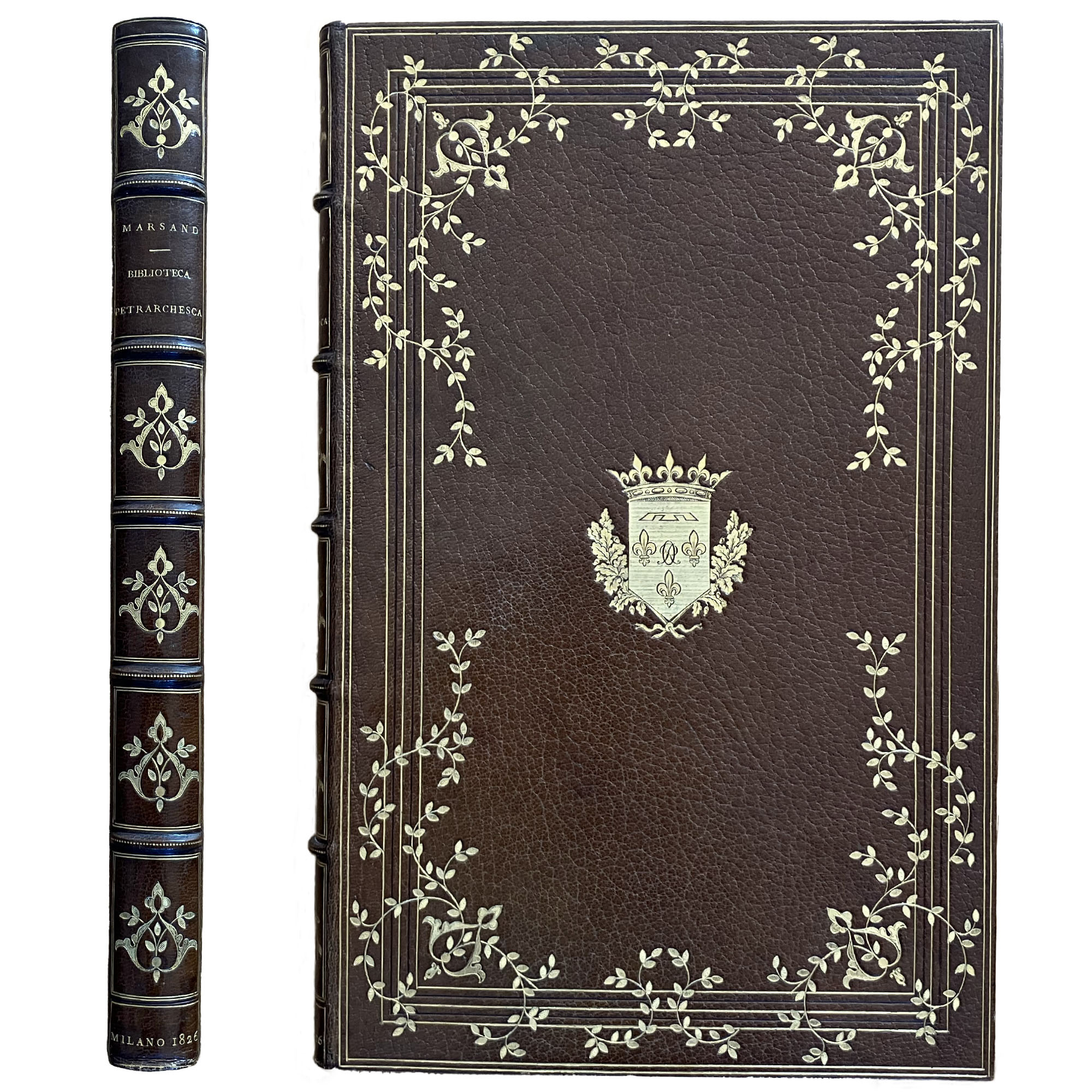
R. d'ORLEANS COPY - Bibliotheca Petrarchesca..., by A. Marsand
Milan, Italy: Paolo Emilio Giusti, 1826
Description: MARSAND, Antonio (1826), Bibliotheca Petrarchesca, formata, posseduta, descritta et illustrata dal Professore Antonio Marsand. Milano: printed privately by Paolo Emilio Giusti, 1 p.l. (errata), XXXVIII, [2] (blank), 280 pp. Large paper copy (quarto, 305 x 193 mm tbd) printed on wove paper, with vast margins. No. 15 of 150 copies. Bound for Robert d'Orléans, duc de Chartres, by Antoine Chatelin, London, c. 1865 (stamp-signed on verso of front free endpaper), in hazel brown crushed levant morocco, the sides decorated with gilt and blind rules intertwined with laurel branches, fleurons at the corners and the Duke's crowned arms with his monogram in the centre. In a modern tan linen clamshell lined with felt, red morocco label to spine, two snap closures (one of them defective). Description slip from Christie's 2005 sale laid in at front - This is the copy bound for the grandson of the monarch who tried to preserve the collection on which this bibliography, Marsand's collection catalogue, was based.
Provenance: Robert d'Orléans, duc de Chartres • ... • Bernard H. Breslauer. Robert d'Orleans, duc de Chartres (1840-1910), second son of Ferdinand-Philippe d'Orléans, eldest son of King Louis-Philippe, was a soldier, historian and book collector. His collection contained some 5,000 works. After the February Revolution of 1848, his family was forced to flee to England, which included his uncle Henri d'Orléans, Duke of Aumale, noted bibliophile.
References: BBB Wittockiana no. 36 of 75 (one page description p.84, full-page illustration p.85); BBB Harvard no. 28 of 73, p.16; Christie's (2005:lot.97) - The same books were displayed at both exhibitions (with the exception of two) and were chosen for their remarkable and aesthetically pleasing bindings ("the choix devenu définitif a privilégié les exemplaires dont les reliures contribueraient le plus au plaisir et à l'information du visiteur" - J. Toulet). It is listed in the Christie's auction catalogue of the first portion of the BBB, which contained "most of Dr. Breslauer's favorite books".
Select a thumbnail to view its caption.
COMING LATER
II. Book as Object (Manuscripts, Bindings & Books on Books): The French Sphere
TEXT COMING LATER
COMING LATER
Henri d'Orléans, duc d'Aumale (1822-1897) was the greatest bibliophile and art collector of his time. He was the youngest son of Louis-Philippe of Orléans (1773-1850), the last King of France during the period 1830-1848, and the grand-nephew and godson of Louis-Henri-Joseph, duc de Bourbon, prince de Condé (1756-1830). From the latter, he inherited a colossal fortune, including the Château de Chantilly, where he passionately added to and enhanced the treasures amassed by the castle's former owners, the Princes of Condé. According to his own words, the Duke of Aumale became "decidedly bibliomaniac" around 1850, during his exile in England (following the French Revolution of 1848 and lasting until 1871), all the while secretly managing to retain ownership of the castle. He multiplied his acquisitions across Europe, purchasing from booksellers and attending major auctions. Among his most notable acquisitions was the Book of Hours Les Très Riches Heures du duc de Berry, one of the most precious manuscripts in the world. He had a deep passion for the oldest, rarest, and most valuable books, and, for instance, owned several Grolier bindings. Beyond bibliophilia, he also assembled the second largest collection of antique paintings in France, surpassed only by the Louvre Museum at the time. In the late 1870s, he undertook the reconstruction of the Château de Chantilly and transformed several rooms into museum spaces, such as the Reading Room and the Gallery of Painting, designed by the architect Honoré Daumet, to display his collections. In 1886, the Duke of Aumale donated the Château de Chantilly and its collections to the Institut de France, reserving usufruct for himself. Upon his death in 1897, full ownership passed to the Institut, and the estate became the Musée Condé.
- PICOT, E. (1890), Catalogue du Cabinet des Livres de Chantilly. Spécimen. Paris: Damascène Morgand, 48 pp. [in coll.: One of 50 copies, here inscribed by the editor: "A Monsieur ? Bocher. Hommage empressé de l'éditeur D. Morgand." de Ricci (1918) wrote: "[Emile Picot] avait rêvé de cataloguer le Cabinet des Livres de Chantilly sur le même plan et avec la même ampleur que la bibliothèque Rothschild ; il en publia au moins un charmant Specimen qui est lui-même une rareté bibliographique (Tiré à 50 ex.)."]
A Rare Set of Photographs of the Chantilly Castle & of its Collections by Chalot
_2.jpg)
_1.jpg)
_3.jpg)
Château de Chantilly
Chantilly, France: A. Chalot (photographer), c. 1885
Description: Photographs of the Château de Chantilly, its Reading Room, and its Gallery of Painting (with view of the Rotunda), by Alphonse Chalot. Original photographs mounted on cardboard. Another cardboard piece, not shown here but part of the collection, bears the photographer's signature: "Chalot, Photographe, 18 rue Vivienne, Paris." — Following the reconstruction by architect Daumetof the Château de Chantilly (mutilated since the Revolution), the Duke of Aumale entrusted Alphonse Chalot, a native of Chantilly, with photographing the castle and its park in 1885-86. These historic photographs offer a rare glimpse into his collections: nearly 19,000 books are displayed in the Reading Room, including 1,500 manuscripts. The Gallery of Painting stands as an exceptional example of nineteenth-century museography: paintings are hung in multiple tiers, frame to frame, arranged by format rather than chronology, reflecting the Duke of Aumale's personal taste. In accordance with his wishes, the layout of these collections has remained unchanged to this day. Chalot's photographs of the collection are well known, with many preserved at the Musée Condé.
Select a thumbnail to view its caption.
A Fine Binding from the Duc d’Aumale’s Library for One of His Scholarly Work on Early Manuscript Collections
.jpg)
AUTHOR COPY - ... deux petites Bibliothèques françaises du XVe siècle
London: Philobiblon Society, 1855
Description: Orléans, Henry d’ (1855), Notes sur deux petites Bibliothèques françaises du XVe siècle. Bibliographical and Historical Miscellanies [of the] Philobiblon Society, I, 64 pp. Followed by Lettre de Guillaume III, 5 pp.. In-8, full midnight blue morocco binding signed by Capé, spine with raised bands richly decorated with gilt fillets, motifs, and arabesques, covers framed with a triple gilt fillet, featuring fleur-de-lis at the corners, gilt edges. Duke of Aumale's coat of arms (HO) at the centre of both covers, bearing the motto born of exile "J'attendrai" (I will wait). Ex-dono manuscript (signature illegible): "Offert à Mr F. Ferroud en souvenir de bonnes relations, Paris, ce 10 mars 1910." The Duke of Aumale commissioned works from the finest binders of his time (Trautz, Capé, Duru), and in 1850, he remarked, "I know rare books are expensive; I know that beautiful bindings are too; but I love both, and especially the two together, and I want to pay the price they deserve." The present copy, bound by Capé, stands as a prime example of exquisite bookbinding - An invaluable work by the Duc d'Aumale on two early fifteenth-century manuscript collections, which he discovered within the book collection inherited from the last Prince of Condé. By identifying recurring coats of arms, he was able to reassemble the libraries of Antoine de Chourses (?-1485) and his wife Demoiselle Katherine de Coetivy, as well as of Jean Du Mas, seigneur de L'Isle (1437-1495). Including a detailed list of the books in these collections, this work can also be regarded as a collection catalogue. The author's passion is evident in his writing, providing rich bibliographical details about each manuscript, its physical characteristics, and provenance.
Provenance: Henri d'Orléans, duc d'Aumale
Select a thumbnail to view its caption.
Jean Grolier de Servières (1489-1565) was one of the great book collectors and bibliophiles of the Renaissance. He was a French nobleman, Treasurer-General of France, and a diplomat, but he is perhaps best known for his extraordinary contributions to the world of book collecting and his profound love for books. His collection was not merely extensive but also carefully curated, reflecting his sophisticated taste and deep appreciation for literature, art, and scholarship. Grolier's library included works from various fields such as theology, science, literature, and the classics, making it a comprehensive repository of knowledge and culture of his time. One of Grolier's most notable contributions to book collecting was his commissioning of exquisite bindings for his books. He employed the finest craftsmen to create custom bindings, often decorated with intricate gold tooling and his personal emblem. These bindings were not just protective covers but works of art in their own right, showcasing the pinnacle of Renaissance bookbinding craftsmanship. His famous motto, Io. Grolierii et amicorum [Jean Grolier's and his friends'] (Fig. 1), inscribed on many of his books, indicates his belief that books were meant to be shared and enjoyed among friends and fellow scholars. This motto exemplifies the Renaissance humanist ideal of knowledge and beauty being communal treasures. For instance, his interest in classical antiquity was reflected both in a marvellous coin collection, mentioned by Jacopo Strada, and by his financing of the publication of the second edition of Budé's fundamental treatise on coins in 1522. Over the past centuries, Io. Grolierii et amicorum has become synonymous with the ultimate book collectible desideratum, with Grolier books among the principal treasures of libraries and collectors fortunate enough to possess them (e.g., Nixon, 1965). Jean Grolier's legacy endures through the Grolier Club, founded in New York in 1884 by a group of book lovers and collectors who named it in his honour. As indicated by the leading Grolier scholars, de Thou and Le Roux de Lincy, "rien de plus beau que les livres provenant de Grolier".
WANTED: A Grolier binding • Late 19th-century etching of Grolier in the House of Aldus by Léopold Flameng (Grolier Club, signed, one of 100 numbered copies)
_Grolier(leRouxdeLincy1866)_plate6.jpg)
Fig. 1. Plate 6 from the Plate volume of Recherches sur Jean Grolier... (1866).
Antoine-Jean-Victor Le Roux de Lincy (1806-1869) was a French librarian, Romanist, and medievalist. Appointed to the Bibliothèque de l’Arsenal, he also served as secretary of the Société des Bibliophiles Français. A devoted bibliophile, he pursued bibliographical research both to enrich his own collection and to disseminate his knowledge through publication. Among his works are La Bibliothèque de Charles d’Orléans à son château de Blois, en 1427 (1843), Inventaire des livres composant la bibliothèque des seigneurs de Jaligny, 6 juin 1413 (1844), Catalogue de la bibliothèque des ducs de Bourbon en 1507 et en 1523 (1850), and Notice sur la bibliothèque de Catherine de Médicis (1859). He also published biographical and bibliographical notices on several contemporary bibliophiles, including Armand Cigongne, Nicolas Yemeniz, Alexandre-Charles Sauvageot, and Jacques-Charles Brunet. His most enduring contribution to bibliography, and the work to which he devoted the greatest effort, is Recherches sur Jean Grolier... (1866). As the first monograph devoted to the reconstruction of a private Renaissance library, it remains the fundamental reference on Grolier's collection and bindings. The deluxe edition is illustrated with six chromolithographic plates, three reproducing Grolier bindings (all shown here). The TC preserves an exceptional extra-deluxe copy in which the plates were issued unfolded in a separate portfolio rather than folded into the volume, making it one of the most desirable editions for collectors of Groliana.
- NIXON, Howard M. (1965), Bookbindings from the Library of Jean Grolier, a Loan Exhibition 23 September – 31 October 1965. London: The Trustees of the British Museum, 75 pp., plates A-K (bookbinding tools), plates I-CXXVII (bindings) [in coll.: Frank Broomhead bookplate, signed and dated "F. Broomhead 19.10.65", with two folded newspaper clippings tipped in, one dated 23 August 1904 from the Northern xx (full name cropped) titled Jean Grolier providing a biography of the great humanist and the second one from The Times Literary Supplement from 23 September 1965 titled Grolier's Bindings reviewing the present book - Frank Broomhead was a bookbinding historian]
"The First Classic of Bookbinding Literature" • An Extra-Deluxe Copy with Unfolded Chromolithographs of Grolier Bindings
_Grolier(leRouxdeLincy1866)_plate4.jpg)
_Grolier(leRouxdeLincy1866)_plate5.jpg)
EXTRA-DELUXE COPY - Recherches sur Jean Grolier..., by Le Roux de Lincy
Paris: L. Potier, 1866
Description: LE ROUX DE LINCY, Antoine Jean Victor (1866), Recherches sur Jean Grolier sur sa vie et sa Bibliothèque. Suivies d'un Catalogue des Livres qui lui ont Appartenu. Paris: L. Potier, xlix, 491 pp., 6 plates by M. Pilinski. Extra-deluxe edition consisting of two volumes: (i) In-8, half binding, top edge gilt, other edges untrimmed. Large-paper copy (26 × 17 cm), lacking the six chromolithograph plates normally present in the deluxe edition (here transferred to a separate plate volume), but followed by 13 chromolithograph plates and ten additional plates in black and white (some taken from other publications, others consisting of early reproductions mounted on paper) illustrating Grolier bindings; and (ii) a plate volume (29.5 × 20.5 cm) containing the six deluxe-copy chromolithograph plates, here issued unfolded: pl. 1, p. 84, Armoiries de Grolier avant son mariage; pl. 2, p. 84, Dédicace de Gafori à Grolier; pl. 3, p. 323, Quitance écrite et signée de la main de Jean Grolier; pl. 4, p. 247, first Grolier binding; pl. 5, p. [empty], second Grolier binding; pl. 6, p. 458, Verso de la Reliure de l'Arnobe (No. 18 du Catalogue). Choice and making of the plates described on pages xlvi-xlvii of the book - Described as "the first classic of bookbinding literature" (Breslauer, xxx:16), this work is divided into four parts. It comprises a biography of Jean Grolier; an alphabetical catalogue of books from the Grolier collection; a survey of the earlier and more recent libraries in which these volumes were, at various times, housed; and, finally, a discussion of the author's documentary and material sources. In the preface, the author explains that he undertook the systematic cataloguing of all known Grolier books after observing the rapidly escalating prices achieved by such volumes at auctions and in the antiquarian book trade in the mid-19th century. As he notes (p. 156): "jusqu'en 1835, on pouvait acquérir des volumes de Grolier pour des prix assez modérés. Aujourd’hui, c'est par billets de mille francs qu'il faut compter pour obtenir un seul volume."
Provenance: No ownership mark is present to clarify the provenance of this copy. Another copy, from the library of Edmond Bonnaffé (lot 331 in the 1904 sale), is described as including "nombreuses planches lithographiées en couleurs", which suggests the existence of several extra-deluxe copies, although no mention is made there of a separate plate volume.
Select a thumbnail to view its caption.
III. Milestones in Bibliomania
TEXT COMING LATER
John Ker, Duke of Roxburghe (1740-1804) was a distinguished bibliophile whose celebrated collection included illuminated medieval manuscripts, incunabula, and other exceptionally rare books. He is best remembered for the historic dispersal of his library after his death, an event that reshaped the culture of book collecting and became the defining moment of Bibliomania in the early 19th century. The 1812 auction of the splendid Roxburghe library, conducted by the noted bookseller and auctioneer Robert Harding Evans, drew the rare-book dealers and wealthy private collectors of the time and set unprecedented price records. Among the most famous lots was the Valdarfer Boccaccio, an early edition of The Decameron, which sold for £2,260 to the Marquis of Blandford, a remarkable sum for the period. The auction quickly attained mythological status in the world of book collecting, and in its aftermath, the Roxburghe Club was founded by Thomas Frognall Dibdin (with George Spencer, 2nd Earl Spencer as its first President), becoming the first society dedicated to the appreciation and celebration of rare books. We learn more about the tastes of the Duke of Roxburghe in the preface of the 1812 catalogue: "He idolized the talents of Shakspeare and Cervantes, and collected every thing that could illustrate their works [...] there are in this Library, not only the rarest, but, in point of condition, the most beautiful specimens that exist [...] Among the books printed by Caxton in this Collection, which, in point of condition, and cleanness, are unparalleled in any Library in the world [...] Among the Novellists is the first edition of Il Decamerone di Boccaccio, 1471. This is certainly one of the scarcest, if not very scarcest book that exists [...] But of the rarity of the books, or the beauty of the copies in this Collection, it would be endless to speak."
A Scholar's Priced Copy of the Legendary 1812 'Catalogue of the Library of the late John Duke of Roxburghe'
.jpg)
_inside.jpg)
A Catalogue of the Library of the late John Duke of Roxburghe
London, England: W. Bulmer and Co., 1812
Description: [Roxburghe Library] (1812), A Catalogue of the Library of the late John Duke of Roxburghe, arranged by G. and W. Nicol, booksellers to his Majesty, Pall-Mall; which will be sold by auction, at his Grace's late residence in St. Jame's Square, on Monday, 18th May, 1812, and the Forty-one following days, Sundays excepted, at Twelve o'clock, by Robert H. Evans, bookseller, Pall-Mall. London: W. Bulmer and Co., . Octavo. Old calf and marbled boards, rebacked in half calf with modern endsheets at some point in the last century, gilt label. Forecorners worn, some wear to spine, uniform tanning to textblock, small water-stain to preliminary blank. As with many copies, this copy is bound without the slightly later supplement (iv, 20pp) and the printed price list (73pp). Priced throughout in an early hand. On page 173 an early manuscript note about the historic sale of the Valdarfer Boccaccio and its 1819 resale fills the lower margin. With the bookplates of Randolph Greenfield Adams (1892-1951) and Thomas Randolph Adams (1921-2008). Tipped in front is a sheet of typescript of R.G. Adams's bibliographical notes on this copy, signed in ink with initials and dated 10 September 1942, with an additional note in manuscript about the 1819 Marlborough sale. Adams records the provenance of this copy (he acquired it from Peter Bailey as a discard from the Bay City Public Library) and compares it to copies at the Clements and at the University of Michigan General Library.
Provenance: Randolph Greenfield Adams • Thomas Randolph Adams. R.G. Adams (1942-1951 TBC), bibliographer and historian who served as the first Director of the Clements Library (1923-1951), establishing it as one of the great North American research libraries. Thomas Randolph Adams (1951 TBC-2008) followed in his father's footsteps as bibliographer and historian, librarian of the John Carter Brown Library.
Select a thumbnail to view its caption.
A Very Rare Book from the Legendary Duke of Roxburghe Library
.jpg)
Absconditorum a constitutione mundi Clauis, by Guillaume Postel
n.p. [Basel, Switzerland]: n.p., [c.1547]
Description: 16mo. 52 unnumbered ff. Italic letter, occasional Roman. Light browning to first, slightly toned in places. Handsomely bound in 18th century crimson morocco, marbled endpapers, bordered with gilt floral roll, gilt armorial centrepiece of John Ker, 3rd Duke of Roxburghe to covers, spine gilt to a design of fleurons and Greek fillets, all edges gilt and gauffered, corners, head and foot of spine a bit rubbed, ink splashes to covers and spine. 'CP' to verso of ffep, '624' later pencilled, occasional early underlining - The rare first edition of this important work on religious mysticism. The compiler of the 1812 catalogue notes: "It seems to be proper to say, that there is one class of books in this Catalogue, among which there are some very rare ones, that were not purchased by the late Possessor. They were collected early in the late century, when free-thinking was much the fashion. William Postel, Giordano Bruno, or Benedict Spinosa, could be no favourites with the late Proprietor, who only valued philosophical writers, in proportion as they improved the morals of mankind" (p.16). This book likely originated with the 2nd Duke and was later incorporated into his son's celebrated library for its rarity.
Provenance: John Ker, 3rd Duke of Roxburghe • John Broadley
References: Roxburghe auction catalogue (1812:lot 624); Evans (1833:lot 321). R.H. Evans' Catalogue of the second portion of the library, prints and original drawings of John Broadley, Esq. records six works by Postel in red morocco, including the present copy. Four of these (lots 319, 321, 322, and 323) correspond to the same titles sold at the 1812 Roxburghe auction (lots 626, 624, 625, and 623, respectively). Given the rarity of these works, it is highly likely that at least four of Broadley's Postel volumes originated from the Roxburghe library and retain their identical red morocco bindings. Notably, a digitized copy of the 1812 catalogue shows that all four lots were acquired by the same buyer, identified as 'Massey' (TBC). It is also worth noting that the 1812 catalogue dates all four works to 1552, whereas Evans's 1833 catalogue corrects the date to 1547 for the present copy.
Select a thumbnail to view its caption.
.jpg)
de Thou's portrait on a 1861 token from the Société des bibliophiles français.
Jacques Auguste de Thou, Thuanus (1553-1617), was one of the greatest book collectors of the Renaissance, alongside Jean Grolier, Cardinal Richelieu, Cardinal Mazarin, and Colbert (Rosenbach, 1927:21). As a councillor of state, he served Henri III and Henri IV, and in 1593 he was appointed director of the Royal Library of France, where he acquired, among other treasures, the manuscript collection of Catherine de Medici. Later, as President of the Parliament of Paris, he played a diplomatic role in the negotiations leading to the Edict of Nantes. Alongside his political and diplomatic career, he was a distinguished historian of contemporary Europe and its religious conflicts. His 1604 work, J. A. Thuani historiarum sui temporis pars prima, was later condemned and placed on the Index librorum prohibitorum because of his denunciation of the persecution of religious dissenters. The work also contains a notice on Grolier, in which we learn that Grolier's life had been saved by de Thou's father, Christophe de Thou, who defended him against unfounded accusations (notice reproduced in Le Roux de Lincy, 1866:110). De Thou's historical writing was closely connected to the creation and development of his library in Paris, which served as an active working collection as well as a monument to his intellectual pursuits. He possessed what was described as "the finest library of his time [and] was the truest type of book lover. He had not one but several copies of each book for which he felt a particular affection; he ordered them printed on the best paper obtainable, expressly for himself. His bindings are richly beautiful, made of the finest leathers and exquisitely designed. They are easily recognizable, as his armorial stamp, with golden bees, appears on the covers, while the spine bears a distinctive cipher formed from his initials" (Rosenbach, 1927:24). Among his holdings were, for example, eight volumes bearing Grolier bindings, and his collection also incorporated the books inherited from his father Christophe de Thou, who had received four volumes as gifts from Grolier (Le Roux de Lincy, 1866:xj, 92). Like other major collectors of the second half of the 16th century, de Thou actively sought to acquire Grolier's books (Le Roux de Lincy, 1866:118). His exceptional reputation as a collector led Le Roux de Lincy to describe him as "the Prince of Bibliophiles" (1866:xxxix). De Thou's library was the first in Paris to be opened to the public; only with the foundation of Cardinal Mazarin's library did a genuinely public library become established in 1643 (Pomian, 1987:56).
The posthumous history of Jacques-Auguste de Thou's library further established its importance in the history of book collecting. The dispersal of the collection was not, in itself, the defining event; rather, it was the creation of the Catalogus Bibliothecae Thuanae (1679) that transformed the library into a landmark of bibliophilia. Far more than a simple sale catalogue, it became one of the most celebrated and frequently consulted catalogues of a 17th-century private library. According to Bernard Breslauer, "most of the descriptions are by the well-known scientist Ismael Boulliau (1605-1694), who arranged them according to a bibliographical system which, with slight variations... was one of the most frequently adopted in France and became known as the 'Système des Libraires de Paris'" (Christie's, 2005). The catalogue thus contributed not only to preserving the memory of de Thou's collection but also to the development of bibliographical organization in early modern France. De Thou's reputation as a collector was so great that, centuries later, he was chosen as Dean of the Société des Bibliophiles Français, presided over in the 19th century by the celebrated bibliophiles Duke of Aumale and Baron Jérôme Pichon.
WANTED: Catalogus Bibliothecae Thuanae (1679).
The Bibliothecae Thuanae Copy of a Chivalric Book, Part of Don Quixote’s Fictional Library
.jpg)
Historia del Valorisissimo Cavallier della Croce
Venice: Pietro Deuchino, 1580
Description: De Salazar, Alonso (1580), Historia del Valorisissimo Cavallier della Croce. Venice: Pietro Deuchino. Binding of the finest leather, with typical plain brown boards with minimal tooling, bearing on each side the gilt coats of arms of Jacques Auguste de Thou (while still a bachelor, pre-1588). '(J4)' de Thou shelf mark written on the front board. Canting arms made of a chevron between three horseflies (in French = 'taon' = Thou), and his initials. Boards worn with edge and corner wear and some rubbing; front joint cracked and worm hole at bottom of spine; spine possibly professionally rebacked; ink notes by old hand on title page. Stored in modern clamshell case - This is a rare book with only three copies of this edition listed in Worldcat. The original Spanish version was first printed in 1521. Cervantes mentions this book in Don Quixote, the Knight of the Cross being one of the instigating books in Don Quixote's library and was subsequently burnt by the priest, niece and housekeeper for being the genesis of Don Quixote's troubles.
Provenance: Jacques Auguste de Thou (pre-1588) • de Thou's sons (1617-1680) • Jean-Jacques Charon, Marquis de Ménars (1680-1706) • Armand de Rohan (1706-1749) • Charles de Rohan, Prince de Soubise (1749-1788) • ... • Kenneth Rapoport (?-2022 TBC)
References: Catalogus Bibliothecae Thuanae (1679:409); Prince de Soubise auction catalogue (1788:lot 5342)
Select a thumbnail to view its caption.
IV. Manuscript Collections
TEXT COMING LATER
At the beginning of the 17th century, it was extremely rare for a private, provincial, lay collection to gain any reputation. The admiration is therefore all the greater for the treasures of the Bigot family. Dean of the counselors in the Court of Aids of Normandy, Jean Bigot (?–?) spent enormous sums for the time in building his library of six thousand volumes, including several hundred manuscripts, by 1644. His manuscript collection was the richest ever built by an individual in Normandy, with specimens procured from other amateurs as well as from abandoned monasteries (Delisle, 1877:iii-v). His son Louis-Émeric Bigot (1626-1689) inherited the library and significantly increased its holdings. This celebrated regional cabinet was sold at auction in 1706 after being bought by a group of Parisian booksellers, Jean Boudot, Charles Osmont and Gabriel Martin. Bibliotheca Bigotiana was the first book auction in Paris for which a catalogue was printed. The notice to the reader of the catalogue indicates that "inspired by ancestral examples and following in his father's footsteps, [LOUIS EMERIC BIGOT] resolutely undertook the augmentation and embellishment of the BIGOTIANA Library, which was already renowned at that time for the number and selection of both manuscripts and printed books, regardless of the cost, care, or industry required." The books of the famous Jacques de Mesmes library, for whom Gabriel Naudé had dedicated his Avis pour dresser une bibliothèque in 1627, were dispersed alongside the Bigot library. The volumes were included anonymously, despite their historical value, to the Bibliotheca Bigotiana catalogue by the three Parisian booksellers.
- Delisle, L. (1877), Bibliotheca Bigotiana Manuscripta. Rouen, France: Henry Doissel, 105 pp.
A Partially-Priced Copy of the First Parisian Book Auction Catalogue
.jpg)
_priced.jpg)
Bibliotheca Bigotiana seu catalogus librorum..., by G. Martin
Paris: Apud Joannem Boudot, Carolum Osmont, Gabrielem Martin, 1706
Description: Martin, Gabriel (1706), Bibliotheca Bigotiana seu catalogus librorum, quos (dum viverent) summa cura & industria, ingentique sumptu congessere viri clarissimi DD. uterque Joannes, Nicolaus, & Lud. Emericus Bigotii. Paris: Apud Joannem Boudot, Carolum Osmont, Gabrielem Martin. Five parts in one volume, I-II: 220 pp., III: 248 pp., 59 pp., IV: 31 pp., V: 31 pp. Contemporary binding, brown calfskin, spine with raised bands adorned, title label in red morocco. An angular page loss with some characters missing p.21 of part IV. Marginal notes in ink and pencil giving the prices realised on c. 75 pages. Unknown owner's name "Gonnant" and a short manuscript biography of Louis-Émeric Bigot - This catalogue comprises about 16,500 items: 2954 in-folio, 4345 in.quarto, 8147 in-octavo, 597 varia in supplement and 450 manuscripts. This is a rare book notable on many aspects. The Bigot library sale in 1706 was the first book auction conducted in Paris for which a catalogue was printed. Prior to this auction several auction catalogues for private libraries had been printed in Paris, but these libraries were sold privately and thus never went to auction. This is also the first of the 148 catalogues compiled by Gabriel Martin (1679-1761) in which he employs a novel bibliographical system (books grouped according to sizes, and within them, according to subjects).
Select a thumbnail to view its caption.
A Heraldic Manuscript with Prestigious Jean Bigot Provenance
_binding.jpg)
_exlibris.jpg)
_inside.jpg)
French treatise on heraldry and armorial
France: Anonymous manuscript, c. 15th century
Description: In-4 (191 x 135 mm). (1) leaf, 96 pp., (12) pp. Elegant seventeenth-century binding of tan polished calf
over pasteboard, decorated spine with gilt lettering (partly erased): "Armaries. T. L. M. S." (TBC) and gilt armorial, double gilt fillets
forming frame on boards. Jean Bigot's armorial bookplate (9 x 11 cm engraving) pasted on the front pastedown, with his name "Johannes Bigot".
Bigot's shelf-mark number on front pastedown 'D 15'. French manuscript with polychrome illuminations containing a treatise
on heraldry, illustrated with 34 coats of arms, followed by an armorial comprising 447 coats of arms with their identification
and heraldic description. At the beginning of the manuscript, there is an annotated leaf containing 2 coats of arms, bringing the total to
483 drawn and watercolor-painted coats of arms. The text, in a late fifteenth-century Gothic script, has approximately 15 lines per page,
usually with 6 coats of arms per page. At the beginning of the manuscript is a leaf containing two pages filled with cursive writing,
barely legible. It appears to be an acknowledgment of debt, dated August 14, 1594. This is followed by two large unidentified coats of arms.
An 11-page index of names was added at the end of the volume in the seventeenth century (possibly by Jean Bigot). A loss of paper on pp. 41-42
removes a coat of arms with its corresponding text".
This manuscript, of prestigious provenance, with finely executed and painted heraldic shields likely executed by a skilled arms painter,
remaining anonymous, was probably excerpted from the armorial of the herald Navarre, a collection created around 1368-1375 containing
descriptions of over 1,500 coats of arms. According to Saffroy, its author would be Martin Carbonnel, herald to Charles the Bad, king
of Navarre. While the original is now lost, the BnF preserves a few manuscript copies. One of these is titled Blazon et deviz des armes
de tous les Roys chrétiens Princes et seigneurs du sang de France et autres barons, baneroys et chevaliers du Pays de France, Normandie,
Champaigne, Bourgongne, Bretaigne, le Maine, Anjou, Tourayne, Vermandoys, Beauvoisin, Pontif, Artois, Corbyois, Poitou, Berry, Breban,
Flandres, Henault et Angleterre (ms. fr. 14356, fifteenth century, on paper, 130 pp.). The present manuscript appears to be an excerpt
from one of the manuscript copies of this famous armorial.
Provenance: Jean Bigot, seigneur de Somesnil. The Bigot collection was dispersed at auction in 1706. The manuscripts were purchased in bulk by the Bibliothèque Nationale. Léopold Delisle catalogued them in 1877 as Bibliotheca Bigotiana Manuscripta. Some volumes remained in the family and were probably dispersed through inheritance.
Select a thumbnail to view its caption.
V. Collecting Leaves
TEXT COMING LATER
Otto F. Ege (1888-1951) was an American educator, calligrapher, and bibliophile whose controversial legacy modified the landscape of rare book collecting in the modern era. A long-time professor of art and design at the Cleveland Institute of Art, Ege was driven by a desire to make rare manuscripts accessible to a wider public. He became best known for his practice of dismantling medieval and early printed books, often damaged or incomplete, and distributing the leaves in curated portfolios to universities, museums, and private collectors. Self-proclaimed biblioclast, criticised by some, he created the twentieth-century market for medieval manuscript leaves in America. He is best remembered for his portfolios of rare book leaves that he started to compile in the 1940s. Today, Otto Ege leaves are widely studied as artefacts of both medieval bookmaking and twentieth-century collecting practices, offering insight into evolving ideas about preservation, accessibility, and the value of the book as object. The Original Leaves from Famous Books (Nine centuries, 1122-1923 A. D.) is one such portfolio (see below), which presents a deliberately crafted overview of the central pillars of rare-book collecting. Through 40 leaves drawn from manuscripts and printed books, it traces the evolution of the written and printed word across nearly a millennium. The selection highlights authoritative works, distinguished printers, and other must-have items. It showcases from specimens of early medieval script and illumination, as well as the rise of influential presses, from incunable-era workshops to major early modern printers, illustrating shifts in typographic design, paper quality, and technical innovation. As a whole, the portfolio functions not merely as a sampling of notable texts, but as a compact survey of what collectors and scholars have long deemed most significant.
- DE HAMEL, C., SSILVER, J. (2005), Disbound and Dispersed: The Leaf Book Considered. Chicago: The Caxton Club, 152 pp. [in coll.; With dust jacket, faded spine]
Deluxe Edition of an Ege Portfolio, no. 28 of 50, or a Collection of Leaves from the Most Collectible Books
_BookofHoursIlluminatedManuscript.jpg)
_box.jpg)
_StJeromeVulgateBible.jpg)
_Dante1491DivineComedy.jpg)
Original Leaves from Famous Books. Nine Centuries 1122 A.D.-1923 A.D.
New York: Philip C. Duschnes, c. 1949
Description: Deluxe edition of 40 leaves in total, six manuscript and 34 printed, including five from incunabula, various sizes (15 x 10 cm to 42 x 28 cm); leaves extracted from damaged or incomplete copies by Ege, from volumes in his collection. Printed introductory leaf listing the collection's contents, each leaf hinged to a paper mount with a printed description on an attached slip. In the original brown buckram box, no. 28 of 50 numbered sets (label slightly torn). Compiled by Otto Ege, this elaborate portfolio was one of his later productions. This is the deluxe edition (Nine Centuries) of 40 leaves issued in 50 sets (a regular version of Eight Centuries was issued in 110 sets of 25 leaves) (de Hamel and Silver, 2005:Catalog-Checklist no. 20/98, pp.79-82, 120). The specimens represent texts in various languages (mostly Western) and by many notable authors, including Homer, Aristotle, Cicero, Ovid, Pliny, Virgil, Dante, Petrarch, Boccaccio, Erasmus, Chaucer, Cervantes, Shakespeare, Milton, Montaigne, the Beowulf poet, and the translators of the King James Version. The specimens represent many renowned printers in Western Europe and the United States, such as Nicolas Jenson, Aldus Manutius, Robert Estienne, Lucantonio Giunta, Bodoni, the Kelmscott Press, and the Riverside Press. Not forgetting, among others, a specimen from the Nuremberg Chronicle of 1493 and from the Fourth Folio of 1685. Of the several portfolio created by Ege (Medieval Manuscripts, Famous Bibles, Oriental Manuscripts), Original Leaves from Famous Books is the most educational in terms of rare book collecting in general.
Provenance: Otto Ege (1940s) • Bruce Ferrini • Alexander E. Vida. Bruce Ferrini was one of the foremost dealers in Western Medieval and Renaissance Illuminated Manuscripts in the world. A.E. Vida (?-2018) was an avid book collector.
Select a thumbnail to view its caption.
VI. Bibliophilic Curiosities
TEXT COMING LATER
COMING LATER
In 1840, booksellers, collectors, and librarians received an auction catalogue announcing the sale of the library of the Comte de Fortsas, a man said to collect only unique books, works of which only a single copy was known to exist! Naturally, the prospect electrified the bibliophilic world. Numerous collectors traveled to Binche, Belgium, hoping to bid on these extraordinary items. Upon arrival, however, they discovered that the auction address simply did not exist. The legendary Fortsas catalogue, which famously lists the 52 imaginary books of the imaginary Comte de Fortsas, remains the sole documentation of the celebrated so-called Fortsas hoax of 1840. The deception had been orchestrated by the antiquarian Renier Hubert Ghislain Chalon. Only 132 copies of the catalogue were printed, along with 73 copies of the “Avis” sheet, in which Chalon announced that the sale had been cancelled and that the books had been acquired en bloc by the public library of the town of Binche. Owing to its historical importance, several later editions were produced: a second printing (recognizable by minor typographical differences); the 1850 facsimile published in the Journal de l’Amateur de Livres (rarely noted in studies of the Fortsas hoax); the Brussels edition of 1856; the Lyon edition of 1863; and others (Quérard, J.-M. (1869), Supercheries Littéraires Dévoilées).
The first facsimile of the 'Catalogue... de la bibliothèque de feu Mr. le Comte J.-N.-A. de Fortsas', one of 150 copies published in 1850
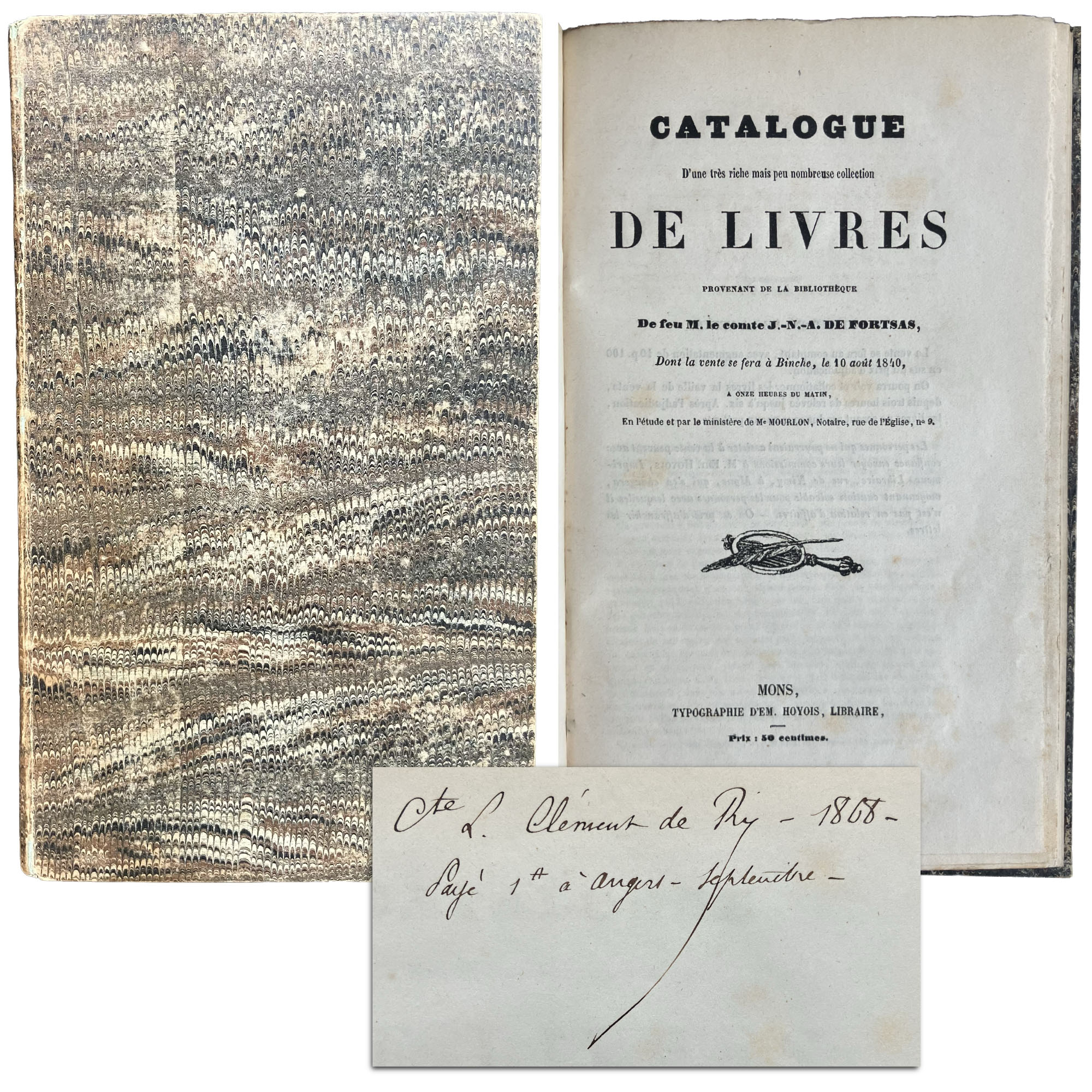
de RIS COPY - Catalogue... Comte J.-N.-A. de Fortsas (facsimile)
Paris, France: M. Jannet, 1850
Description: [Chalon, R.H.G.] (1840, repr. 1850), Catalogue d'une très riche mais peu nombreuse collection de livres provenant de la bibliothèque de feu M. le comte J.-N.-A. de Fortsas, dont la vente se fera à Binche, le 10 août 1840 à onze heures du matin, en l'étude et par le ministère de Me Mourlon, Notaire, rue de l'Église, n°9. Mons, Belgium: E. Hoyois, Libraire. Facsimile reprint in Journal de l'Amateur de Livres, comprising title page, preface, and pp. 141–152. Contemporary binding in comb-pattern paper boards; fold to upper cover, original to the binding process and reinforced on the verso with thick paper, likely to prevent splitting at the joints. Binding typical of those commissioned by Count Clément de Ris, here bearing his inscription: "Cte L. Clément de Rys – 1868 – Payé 1 fr. à Angers, septembre." Ink annotation in the journal postface: "En mai 1850 un exemplaire a été vendu 26fr50, no 1371bis Baudeleveque [TBC]." This edition constitutes the earliest facsimile, and arguably the closest substitute, for the original 1840 Fortsas catalogue. Issued in 1850 as a supplement to the Journal de l'Amateur de Livres separately printed in an edition of 150 copies (barely exceeding the original edition), it remains comparatively scarce. The journal itself was published by the bibliophile Pierre Jannet between 1848 and the early 1850s. The postface to the facsimile (pp. 151-152) underscores the historical significance of the 1840 Fortsas catalogue, reproduces a letter by Baron de Reiffenberg identifying works of interest to the Bibliothèque Royale de Belgique, and concludes: "Le catalogue de Fortsas avait été tiré à petit nombre. Il est rare depuis long-temps et se paie fort cher dans les ventes. Nous croyons faire plaisir à nos lecteurs en réimprimant cette facétie, une des meilleures de ce genre, sans y rien ajouter ni changer." It should be noted, however, that the typographical layout of the title page differs from that of the original edition. Newspaper clipping tipped in, titled Bibliofolie, Des lots vides (by B. Galimard Flavigny, c. 2005).
Provenance: Louis Clément-de-Ris (1868-1882 TBC). Louis Clément de Ris (1820-1882) was a famous collector and museum curator at the Louvre. He wrote several books on the history of collections.
Select a thumbnail to view its caption.
VII. Literary Genre Libraries
TEXT COMING LATER
COMING LATER
"Acquire as many books of the right sort as you can afford to house, for ownership means easy and repeated access and permanent usefulness. Don't be a foppish hoarder of fine bindings and first editions. Get books for what's in them, and be glad enough of that."
H.P. Lovecraft, Suggestions for a Reading Guide, 1936 (published posthumously, 1966)
Howard Phillips Lovecraft, H.P.L. (1890-1937), the central figure of early twentieth-century weird fiction literature, the master of cosmic horror, also plays an important role in the world of book collecting. Although his personal library was primarily a working collection, it has since been celebrated through the catalogues of Joshi & Michaud, which have helped render books from his library legendary among collectors (Joshi and Michaud, 1980). Lovecraft was also a bibliophile, not for fine bindings, but for the significance of the texts. His love of books is evident in the prominent role that rare and antiquarian volumes play in his fiction, most famously in the fictional grimoire Necronomicon, for which he devised an elaborate bibliography complete with the supposed provenance of surviving copies. HPL also wrote the essays Supernatural Horror in Literature (1927), one of the finest historical analyses of horror literature, and Suggestions for a Reading Guide (1936), in which he outlines how to build a comprehensive personal library, both demonstrating the breadth and depth of his literary knowledge. His bibliophilic interests are further attested by a pair of postcards in the TC (see below), in which Lovecraft expresses his appreciation for the "splendid" bookplates created by Talman for his volumes, which he immediately affixed to his "Poe, Machen, & Dunsany" (seminal, foundational figures in weird fiction, gothic horror, and fantasy). From another perspective, the relative scarcity of Lovecraft's works in their original forms, combined with their complex posthumous publication history and the recurring importance of books within the texts themselves, has given rise to a distinctive and rich field of collecting often referred to as Lovecraftiana. Original materials (manuscripts, letters, and related documents) are especially prized, and typically trace back through several key provenance streams: the Clark Ashton Smith / Roy A. Squires path, the W.B. Talman / Gerry de la Ree line, or the odd and obscure Grill / Binkin / McLaughlin path. The Philip Jack Grill collection, in particular, has been regarded as one of the most extensive assemblages of Lovecraft-related material ever formed (Owings and Binkin, 1975). All these collections have however largely been dispersed by the 2000s. Finally, Lovecraftiana encompasses a small number of scarce and notable works on the subject of collecting itself, including The Lovecraft Collector (1949; 1977) and Tales of the Lovecraft Collectors (Faig, 1979+; 1989).
- FAIG, K.W., Jr. (1989), Tales of the Lovecraft Collectors. Evanston, Illinois: The Moshassuck Press, 77 pp. [in coll.: Photocopy of the original edition of 25 copies, made by the publisher in original white wraps with typed title, inscribed: "For John A. Conners, I hope you enjoy these tales. Kenneth W. Faig, Jr., 2-23-90", Errata page included at the end incl. clear reproductions of lines which didn't copy well due to faint originals]
- JOSHI, S.T., MICHAUD, M.A. (1980), Lovecraft's Library: A Catalogue. West Warwick, RI: Necronomicon Press, 90 pp. [in coll.: copy from the Lovecraft section of the Kennett Neily collection with his inked marks '4-24-80', and '9/4/80' on the Addendum #2 to Lovecraft's Library: A Catalogue, stappled and tipped in]
- OWINGS, M., BINKIN, I. (1975), A Catalog of Lovecraftiana: The Grill/Binkin Collection. Baltimore, MD: The Mirage Press, Ltd., 71 pp. [in coll.: One of 500 copies bound in full black cloth of a total of 2000 copies, signed by editorial and marketing director Jack L. Chalker and dated "Nov 1, 1975 Providence" below colophon. Also inscribed "For Ken Scher from Mark Owings" on title page]
- NO NAME (1977), The Lovecraft Collector. West Warwick, RI: Necronomicon Press, facsimile of the 3 articles which first appeared in 1949 [in coll.: one of 500 copies, no. 195, from the Lovecraft section of the Kennett Neily collection (no marking)]
Postcards from H.P. Lovecraft to W.B. Talman, praising "splendid" bookplates & "cover[ing] Poe, Machen, & Dunsany" with them
_1.jpg)
_2.jpg)
Lovecraft Postcards to Talman
Providence, R.I., USA: Unpublished, 1929
Description: Two holograph postcards from H.P. Lovecraft to Wilfred Blanch Talman (1904-1986), his friend and collaborator who
also designed Lovecraft's iconic ex-libris bookplate:
(i) Featuring an image of the Fairbanks House in Dedham, Massachusetts, postmarked Providence, R.I., August 18, 1929. Lovecraft writes of his
reaction to the receipt of the proof of the bookplate Talman designed for him: "Mynheer, I am knock'd out... I grow absolutely maudlin & lyrical...
The thing is splendid [underlined], beyond ever those high expectations which I form'd from a survey of your pencil design!
You have caught perfectly [underlined] the spirit that I wished to see reproduced" (see full transcript in caption).
(ii) Featuring an image of Manning Hall at Brown University, Providence, not dated, stamped or mailed.
Lovecraft invites Talman and his wife to visit him while in Providence on their honeymoon and again mentions the bookplates: "Bookplates
arrived safely, & I covered Poe, Machen, & Dunsany the very night they came" (see full transcript in caption).
Provenance: Wilfred Blanch Talman (1929-?) • Gerry de la Ree (?-?)
Select a thumbnail to view its caption.
H.P. Lovecraft's 1928 Copy of 'Landmarks of New York' that he "wish[ed] to Gawd [he]'d had [...] during [his] period of residence"
_covers.jpg)
_exlibris.jpg)
LOVECRAFT COPY - Landmarks of New York
New York: City History Club of New York, 1923
Description: Peterson, A.E. (1923), Landmarks of New York. New York: City History Club of New York, 261 pp. with fold-out map, illustrated. 12mo, original blue cloth flexi wrapped illustrated covers, worn and coffee spotted. H.P. Lovecraft bookplate (designed by Talman, see below) on front pastedown and Lovecraft's ownership inscription on the opposite front free endpaper: "H.P. Lovecraft Providence, R.I. May, 1928". This copy is mentioned at least twice by Lovecraft in his correspondence, e.g., "Did I tell you that I virtually covered all the sights in that City History Club book before leaving the NY region last spring? There were some splendid specimens, & I wish to Gawd I'd had the book during my period of residence. Have you followed up all of its leads? Don't miss Gravesend Village -or the regions south of Flatbush in general. You will find that local differences in Dutch architecture occur-all-wood & shingle cottages predominating in the southern Long Island region where stone was scarce" (Letters to Wilfred B. Talman, 2019:104). This copy preserves tangible evidence of Lovecraft's use. Seven pages bear pencilled marginal marks, each drawing attention to passages of antiquarian or architectural interest: "there is within a "Lincoln Museum" and a "Netherland Antiquity Museum" containing prints, clippings and relics" (p.51), "the first home of the College of the City of New York" (p.68), "the (214) Republican Club [...] has a large collection of rare prints and maps of old New York" (p.76), "picturesque Tarrytown" (p.122), "the massive Schwab mansion just beyond stands within the site of the old fort" (p.126), "it was in this locality that the ill-fated excursion steamer "General Slocum" was burned with great loss of life on June 15, 1904" (p.131), and "the Dominick Lynch mansion, a stately, square, stone structure; here was celebrated the first mass in Westchester County..." (p.133). One readily imagines Lovecraft consulting this very volume, using it as a guide to uncover survivals of an older New York. The marginal marks in this copy resonate with the descriptive precision of his tales, where landscape, architecture, and history are not mere background but essential elements.
Provenance: H.P. Lovecraft (1928-)
References: Letters to Wilfred B. Talman (2019:104). Copy not listed in Yoshi's Lovecraft's Library.
Select a thumbnail to view its caption.
VIII. Children's Book Libraries
TEXT COMING LATER
_HarryPotter(photo2007).jpg)
Photograph of J.K. Rowling at the 2007 Sotheby's pre-sale event, by photographer James Peltekian.
The Harry Potter saga by J. K. Rowling stands as the publishing phenomenon of the turn of the 21st century. Few works of modern literature have achieved comparable global reach, cultural impact, or commercial success. It is unsurprising that rare Harry Potter material, such as first editions, their early printings, manuscripts, and associated ephemera, has entered major collections. Chief among these is the first edition of Harry Potter and the Philosopher's Stone, published by Bloomsbury in 1997. The first printing of the hardback edition, limited to just 500 copies (of which roughly 300 were sent to libraries), has become the definitive modern collectible; even severely worn ex-library copies command extraordinary sums. The corresponding first-edition first-printing paperback, produced in a larger printing of approximately 5,150 copies, is likewise coveted as the earliest widely circulated form of the text. Both can reach stratospheric prices, with association copies at the very top of the market. Later printings remain desirable when they bear early signatures or substantial inscriptions by Rowling, written before she achieved global celebrity. Such copies capture a moment when the author's fame was still local and literary rather than universal, and they function as documentary artifacts of the series' nascent years. A decade after the publication of the first novel, and shortly after concluding the series with Harry Potter and the Deathly Hallows in July 2007, Rowling undertook a remarkable afterword to the saga. Having referred within the narrative to a wizardly book of fairy tales, she decided to write The Tales of Beedle the Bard in reality, producing seven individually handwritten and illustrated manuscript volumes. Six were given as personal gifts to individuals most closely connected to the creation of Harry Potter; the seventh was designated for auction to raise funds for The Children's Voice charity. On 13 December 2007, after a prolonged and highly publicised bidding war, the manuscript sold at Sotheby's for £1.95 million, setting a world record for both a modern literary manuscript and a children's book. The auction itself has since become part of the collecting history, and the Sotheby's sale catalogue has emerged as a collectible object in its own right.
_HarryPotter(newspaperclipping).jpg)
Newspaper clipping of article titled Fairytale ending as JK's charity book makes £2m by J. Mills (2007). Notice the Sotheby's auction catalogue in the hands of J.K. Rowling.
A Rare Piece of Harry Potter Ephemera on the 2007 World-Record Sale of 'The Tales of Beedle the Bard'
_HarryPotter(Sothebys_signed).jpg)
_HarryPotter(Sothebys_signed)_inscription.jpg)
The Tales of Beedle the Bard... The Property of J. K. Rowling..., by Sotheby's
London, UK: Sotheby's, 2007
Description: Sotheby's (2007), The Tales of Beedle the Bard, A Collection of Wizarding Fairy-Tales. The
Property of J. K. Rowling, sold on behalf of the Children's Voice. London, Thursday, 13th December 2007.
First edition, only printing. Small octavo. Original white wrappers, spine lettered in white, front wrapper lettered in blue, wrappers with design
embossed in blue – The souvenir auction catalogue includes many photographs of the manuscript and a short introduction by the author.
As part of pre-sale publicity, there was a party held on 10 December 2007. During the event, the
author was kept busy greeting guests and also read one of the stories. Despite these demands on her time, a small
number of copies of the souvenir catalogue were signed for a few guests:
(i) Inscribed by the author on the first page: "to Monique, J. K. Rowling". Accompanied
with a pictorial badge "I have seen Beedle the Bard...", 40 mm diameter with pin. Together with a newspaper clipping
(see above) and two photographs,
each 230 x 151 mm. of J.K. Rowling (and one with presumably, Monique - not shown) at the event, signed by the photographer James
Peltekian on verso (see above).
(ii) Signed by J.K. Rowling to one of the journalists present during the auction. Accompanied with a pictorial badge.
Select a thumbnail to view its caption.
Early Inscribed Copies of Harry Potter and the Philosopher's Stone Documenting the Birth of a Global Literary Phenomenon
_HarryPotter(HP1_inscribed2Beck)_Houston.jpg)
_HarryPotter(HP1_inscribed2Kathleen).jpg)
Harry Potter and the Philosopher's Stone, by J.K. Rowling
London, UK: Bloomsbury, 1997 (paperback ed.)
Description: Two early English paperback printings, each preserved in
a custom-made quarter-leather red clamshell box with bespoke gilt lettering and accompanied by a CoA by Adam
Houston. Together, these volumes capture Rowling's transformation from a little-known author into an international cultural icon.
(i) Twenty-seventh printing, paperback. A remarkably well-preserved copy with only a slight nick to the foot of the spine and a tiny water
mark to the lower edge of the half-title; otherwise in outstanding, unread condition. Inscribed by J.K. Rowling in blue ballpoint to the
dedication page at the 1999 Hay Literary Festival for Lily (aged eight), daughter of acclaimed illustrator Ian Beck: "To Lily – you will know
that I love your name because I used it for Harry's mum! JK Rowling" and featuring Rowling's distinctive 1999 signature variation. Ian Beck,
who knew members of Bloomsbury's editorial and publicity team, was introduced to Rowling, who
happily signed the book for his daughter. The volume remained in the Beck family until 2022, when it was acquired by Harry Potter specialist
Adam Houston. Accompanied by Ian Beck's signed handwritten letter and an email printout dated 22 November 2022 describing the
signing. Beck recalls: "...we noticed a very long queue of parents and children stretching from the entrance of the school and back way into
the main part of the town. At that point we realised something huge was brewing." - This contemporary eyewitness account captures the moment
when Harry Potter stood on the verge of becoming an unprecedented global publishing phenomenon.
(ii) Thirteenth printing, paperback. An exceptionally fine, unread copy bearing a particularly scarce summer 1998 signature variation
together with an unusually long, highly personal inscription: "To Kathleen – Thank you for liking book two even better (that's the one I'm
worried about at the moment! JK Rowling)". Signed at the recipient Kathleen's workplace, the book remained in her possession until 2024.
The inscription captures Rowling at a uniquely early stage of her career, shortly after the publication of Harry Potter and the Chamber
of Secrets. At this point she was still accessible to readers, often taking time to write lengthy, conversational inscriptions that would
become increasingly uncommon as her international fame accelerated. Her candid aside about worrying over the reception of the second book
offers a rare glimpse into the uncertainty of an author who had not yet become one of the world's most celebrated writers.
Provenance: (i) Adam Houston, the Harry Potter specialist (2022-2024)
Select a thumbnail to view its caption.
COMING LATER
Abraham Simon Wolf Rosenbach (1876-1952) was the most influential rare book dealer of the American Golden Age of book collecting. Thanks to a combination of deep bibliographic knowledge, shrewd business acumen, and personal charm, Rosenbach became the trusted advisor and agent of the industrial titans J. Pierpont Morgan, Henry E. Huntington, and Henry Folger. He became instrumental in bringing some of the greatest literary and historical treasures from European libraries to American collections, especially during periods of British economic distress (including copies of Shakespeare's First Folio, Gutenberg Bibles, and precious manuscripts). Rosenbach provided an intimate account of the international book trade in the early twentieth century in his book Books and Bidders, which combines autobiographical reminiscences with broader essays on the nature of the book trade itself, what makes a rare book valuable, and historical notes on famous collectors from the Renaissance to his days (Rosenbach, 1927a). Alongside his business, Rosenbach began collecting juvenile books after inheriting his uncle Moses Polock's library in 1900. This formed an excellent nucleus, prompting him to pursue further rarities and, by the early 1930s, to assemble a comprehensive collection of American and English juveniles (Rosenbach, 1933). Rosenbach first wrote about the making and contents of his private collection of Early American Children's Books in a booklet issued for its exhibition at the New York Public Library (Rosenbach, 1927b), and again that same year in an article published in the May 14, 1927 issue of the Saturday Evening Post (see below). The collection is now preserved at the Rosenbach Museum & Library in Philadelphia.
- Rosenbach, A.S.W. (1927a), Books and Bidders. The Adventures of a Bibliophile. Boston: Little, Brown, and Company, xx pp. [in coll.: Octavo, original brown quarter cloth in its slipcase. Signed limited large-paper issue, number 297 of 785 copies signed by the author on the limitation page, of which 750 were for sale. Contains the red morocco and gilt bookplate of Alfred Sutro on the front pastedown. Alfred Sutro (1869-1945) was a San Francisco lawyer and bibliophile, who served as president of the Book Club of California from 1925 to 1945]
- Rosenbach, A.S.W. (1927b), Early American children's books 1682-1840 : The private collection of Dr. A. S. W. Rosenbach, on exhibition at the New York public library, 1927. NYC: New York public library, 15 pp., 4 pl. [in coll.: In original stiff-card wrappers, inscribed by the author: "?? Williams with the regards of A.S.W. Rosenbach March 20, 1927"]
- Rosenbach, A.S.W. (1933, 1983), Early American Children's Books, With Bibliographical Descriptions of the Books in his Private Collection. Millwood, NY: 1983 Kraus reprint, 354 pp. [in coll.]
A Precious and Unique Memento of A.S.W. Rosenbach's Children's Book Collecting, from the Wilbur Macey Stone Library
_Stone_1.jpg)
_Stone_2.jpg)
_Stone_3.jpg)
_Stone_4.jpg)
STONE COPY - Early American Children's Books, by A.S.W. Rosenbach
Philadelphia: Saturday Evening Post, 1927
Description: A precious copy of the article Early American Children's Books, carefully cut out and
transformed into a unique clipping book by Wilbur Macey Stone (1862-1941), one of the foremost collectors of juvenile books.
Cloth backed paper covered boards, Burgundy cloth, 12 x 16 cm, 37 pp..
This booklet is inscribed by Rosenbach to Stone: "Inscribed for Wilbur Macey Stone with the regard and appreciation of A.S.W. Rosenbach.
August 15 1928". It bears Stone's beautifully illustrated ex-libris Collectanea Juvenilia on front pastedown, as well as two rear
pastedown bookplates: "Smith Collage Library, Northampton Massachusetts, from the library of Marjorie Bache Mendon, Class of 1930" and
M. Bache Mendon personal bookplate.
This unique booklet exemplifies meta-collecting at its most concrete: a scholarly work on collecting, a collectible in its own right,
and simultaneously part of another distinguished collector's library, illustrating how a single item can embody multiple aspects of
collecting practice.
Provenance: Wilbur Macey Stone (c. 1928-1941) • Marjorie Bache Mendon ()
Select a thumbnail to view its caption.
IX. Scientific Libraries
TEXT COMING LATER
"[In the early 1970s] there were very few collectors of rare books on computing, and even fewer rare computing books for sale. However, I found myself buying what I could, and setting most of these items aside in what gradually became a small collection."
Jeremy M. Norman, The Origins of Cyberspace Christie's catalogue, 2005:2
Jeremy Michael Norman, who began his career in the antiquarian book trade in 1964 at the age of nineteen, is one of the world's leading specialists in rare books and manuscripts relating to the history of medicine, science, and technology (e.g., Christie's, 2002; 2007). Together with bibliographer Diana H. Hook, he co-authored The Haskell F. Norman Library of Science and Medicine (2 vols., 1991), which became a standard reference work on classic texts in these fields. The catalogue documented a collection of rare books assembled by his father over four decades. Norman's interest in the history of computing dates to around 1971, after he encountered the historical display wall at IBM's New York office. This coincided with the establishment of his rare book business, Jeremy Norman & Co., Inc., in San Francisco. Over the following years, he acquired whatever material he could find in a field that virtually no one else regarded as worthy of systematic collecting, apart from antiquarian works by figures such as Charles Babbage and other pioneers of computing and telecommunications. As Norman soon discovered, however, 20th-century material was often far more ephemeral than earlier publications. Foundational documents frequently survived only as carbon copies or mimeographed reports produced in very limited numbers and subsequently discarded, making them, in practice, rarer than many antiquarian books on the subject. By 1994, after roughly twenty years of collecting, Norman offered for sale his first collection in the history of computing, consisting of approximately 150 volumes (Norman & Co., 1994; see also Norman & Co., 1992). With the emergence of the Internet, he recognized the opportunity to build a more comprehensive and definitive collection, and between 1996 and 2001, assembled a second library of a thousand items comprising technical reports, books, pamphlets, blueprints, typescripts, manuscripts, photographs, and other ephemera dating from the early 17th century to approximately 1969. Assisted once again by bibliographer Diana Hook and by historian M. R. Williams, Norman published the collection catalogue Origins of Cyberspace (OoC), which has since become the standard bibliographical reference on the history of computing and telecommunications following its publication in 2002. From a contemporary perspective, it is striking that many of the technological achievements of the first half of the 20th century had previously attracted so little attention from collectors and historians, given their profound impact on modern society. Ironically, this neglect contributes to making 20th-century publications among the rarest and most sought-after components of the OoC collection. The Norman OoC library was sold at Christie's in 2005, with all 1,411 original catalogue entries (representing approximately 1,000 individual items) consolidated into roughly 250 auction lots. According to Norman, the 2005 Christie's auction catalogue was "not only the first sale of its kind documenting the foundations of the technologies that led to the Internet, but also a first in the manner of its bibliographical presentation" (Christie's, 2005). Because the books and other documents from the collection do not bear a distinctive bookplate, only inscribed copies and other uniquely identifiable items can be securely linked to the OoC catalogue. As a result, items with a demonstrable OoC provenance are particularly rare.
- CHRISTIE'S (2002), History of Quantum Physics & Theory of Relativity. The Harvey Plotnick Collection sold at Christie's. New York: Christie's, October 4, 2002, 290 pp., 293 lots - According to Norman, "a significant annotated catalogue, and one of [his] better works" including the Development of Quantum Physics and the Theory of Relativity Timeline pp. 16-30 [in coll.: Softcover as issued, with penciled inscription: "For the Tricottet Collection from Jeremy Norman 6-18-2026"]
- CHRISTIE'S (2005), The Origins of Cyberspace. A Library of the History of Computing, Networking and Telecommunications. New York: Christie's, Wednesday 23 February 2005, 247 pp., 255 lots. Intro. (pp. 2-8) by J. Norman, compiler; timeline (pp. 9-28) [in coll.: in softcover as issued, with penciled inscription: "For the Tricottet Collection from Jeremy Norman 6-18-2026"]
- CHRISTIE'S (2007), Anatomy as Art: The Dean Edell Collection. New York: Christie's, 5 October 2007, 248 pp., 229 lots, preface by J. Norman, compiler [in coll.: Softcover as issued, with penciled inscription: "For the Tricottet Collection from Jeremy Norman 6-18-2026 (I wrote this catalogue for Christie's)"]
- JEREMY NORMAN & Co. (1992), Mathematics, Physics, Computer Science, Astronomy. Jeremy Norman & Co. catalogue no. 23, 42 pp. - According to Norman, "the actual beginning of [his] dealing in computing books" [in coll.: Softcover as issued, with penciled inscription: "For the Tricottet Collection from Jeremy Norman 6-16-2026"]
- JEREMY NORMAN & Co. (1994), Classics of Medicine and Science. Rare Books, Manuscripts, Prints. Jeremy Norman & Co. catalogue no. 28, 128 pp. - Incl. 23-pp. description of Norman's first computing book collection titled Charles Babbage & the History of Computer Science [in coll.: Softcover as issued, with penciled inscription: "For the Tricottet Collection from Jeremy Norman 6-16-2026"]
A Copy of the 'Origins of Cyberspace' Bibliography Inscribed to the Tricottet Collection
_Norman(OoCbiblio).jpg)
Origins of Cyberspace, by Hook & Norman
Novata, California: historyofscience.com, 2002
Description: HOOK, Diana H., NORMAN, Jeremy M., with contributions by WILLIAMS, Michael R. (2002), Origins of Cyberspace: A Library on the History of Computing, Networking and Telecommunications. Novata, California: historyofscience.com, x, 670pp. Bound in heavy cloth with silver stamping, edition limited to 500 copies. Inscribed by both author/compilers: "For the Tricottet Collection, Feb. 2 2016. Diana H. Hook, Jeremy Norman" - This is the standard bibliographical reference in the field of computing. It contains 1,411 annotated entries and, beyond providing basic bibliographic information, Hook and Norman document the provenance of each item whenever known, together with a concise account of its historical significance. The 60-page introduction offers not only an excellent overview of the history of computing but also demonstrates how history can be made tangible through the development of a specialised collection, a model that can be applied effectively across many other disciplines. Among the contents of OoC library are key founding documents concering: the first programmable computer, the first electronic computer, origins of the stored-program concept, the first software, the mathematical theory of communications and of data communications, the origins of neurocomputing and of artificial intelligence, landmarks in the history of mathematical logic as they apply to computing, the history of the computer business, the foundation of the world's first electronic computer company, the origins of bioinformations, the origins of telecommunications, the beginnings of electronic computing in the United States and England, and to a lesser extent, in France, Italy, Australia, Germany, Switzerland and Japan. Norman notes in Christie's (2005) that "most of these topics had never been extensively collected by a private collector or dealer before."
Select a thumbnail to view its caption.
Inscribed Volumes on AI from the 'Origins of Cyberspace' Library
_Norman(MachineTranslation).jpg)
_Norman(Wilkes_AI).jpg)
Machine Translation of Languages, edited by Locke & Booth
New York: M.I.T. and John Wiley & Sons; London: Chapman & Hall, 1955
Description: [A] LOCKE, W. N., BOOTH, A. D., eds. (1955), Machine Translation of Languages. New York: The Technology Press of M.I.T. and John Wiley & Sons; London: Chapman & Hall, xii, 243 [1] pp. (first ed.). Original blue cloth, buff printed dust-jacket (extremities a bit worn, faint spotting). Small dampstain on front free endpaper. Inscribed on the front free endpaper: "With the compliments of Andrew D. Booth" with recent penciled note "THIS IS "ORIGINS OF CYBERSPACE" 497. Jeremy Norman 5-30-2026" - "The first book on the application of computers to language translation. The historical introduction, by Booth and Locke, represents the first history of machine translation. Pages 227-36 contain an annotated bibliography of the subject, most of which consists of mimeographed articles" (OoC 497). The book also includes a reprint of Weaver's 12-page memorandum entitled Translation, written on 15 July 1949 and circulated privately to about two hundred people; Weaver's memorandum "was literally the first suggestion that most had ever seen that language translation by computer techniques might be possible" (p. 15). Its importance led to this part of OoC 497 to also be listed as entry OoC 982.
Can Machines Think?, by M.V. Wilkes
Proceedings of the I.R.E., 1953
Description: [B] WILKES, Maurice V. (1953), Can Machines Think?. Reprinted from the Proceedings of the I.R.E., vol. 41, no. 10, October 1953, pp. 1230-1234. Unbound offprint as issued, signed "Maurice V. Wilkes" on the first leaf - "Includes discussions of the principles of computer programming, programming a computer to "learn" by modifying stored information, and the possibility of constructing a generalized learning program. The paper was written for the special computer issue of the Proceedings of the IRE" (OoC 1034). Mentioned in OoC 1034 as being "Wilkes 1999, no. 36".
Provenance: Jeremy Norman, Origins of Cyberspace collection
References: [A] OoC 497; Christie's (2005:featured item of lot 146, erroneously duplicated as part of lot 71). [B] OoC 1034; Christie's (2005:part of lot 227)
Select a thumbnail to view its caption.
COMING LATER
X. Other Libraries
TEXT COMING LATER
_Dearn(Neil1903)_stamp.jpg)
Edwin A. Dearn's Chinese name, 邓英, combining 邓 (Deng), a common Chinese surname, with 英 (Ying), a character meaning "flowers in the meadow" and associated with notions of elegance. The pronunciation can be approximated as resembling "Dearn" when rendered rapidly as Deng–Ying. The stamp is executed in a traditional Chinese seal script (zhuanshu). The seal impression presents the characters in reverse order, 英邓, a format occasionally encountered in traditional seal layouts. The stamp reflects a deliberate and culturally informed aesthetic choice, and suggests Dearn's appreciation of Chinese traditions (pers. comm. Y. Xu, 2026). Red ink stamp (1-cm diameter) on the title page of Dearn's copy of Neil (1903); see below.
Edwin Arthur Dearn (1892-1980), who had a lifelong passion for magic, assembled one of the world's finest collections of magicana. After failing his army medical examination in 1914, he left Birmingham for Shanghai in 1915 to join an uncle, though he soon established himself independently in the city. Already interested in magic from his teenage years, he performed regularly in Shanghai for more than twenty-five years, specialising in ventriloquism and escapology, while pursuing a commercial career. He first worked in the grocery trade, later in gentlemen's outfitting, and ultimately became a director and importer in the well-known firm MacBeth Gray & Co., Nanking Road, Shanghai (Dearn, 1999). Despite the dangers of a lawless country at the time, rife with warlord conflicts, gangs, and Japanese invasions, Dearn took root in the Shanghai International Settlement, home to a large number of wealthy British expatriates under the protection of foreign troops. There, he ran a high-end tailoring business by day, performed on stage at night, and collected magic paraphernalia and books. The Sphinx called him "one of Shanghai's busiest magic performers." His home became a gathering place for many world-famous magicians. Dearn also maintained regular correspondence with fellow magicians around the world, including Harry Houdini and Max Malini, and assembled an impressive collection of books and magic apparatus. Shanghai's English tabloid City Traveler published a full-page feature titled E.A. Dearn's Collection, reporting on his treasured holdings (ref. wanted). According to Mirage (2025), his collection was "hailed as a 'treasure trove of magical treasures from ancient to modern times.' The collection began with the first edition of 'Discoverie of Witchcraft' in 1584, and by 1936 it had grown to over 1,800 volumes, earning recognition from Genii magazine as 'one of the world's largest private magic libraries.' Years later, he claimed to have collected nearly 4,000 books". After being detained by the Japanese army in the 1940s and released in 1945, the Dearn family continued living in China and Hong Kong until 1950, when they relocated to Sydney. Unlike many collections destroyed during the Japanese occupation, Dearn's treasures miraculously survived. Many volumes from Dearn's celebrated library were presentation copies sent by his friends, who were themselves passionate collectors, such as magician John Mulholland and 'ghost hunter' Harry Price. Books from the E.A. Dearn library often contain rich bibliographical details, including notes about the author, the edition, and the chain of ownership, attesting to Dearn's genuine bibliophilia. Four such examples are shown below. The legendary magic paraphernalia of Dearn, alongside his library, remained in the family until the passing of his son Arthur in 2012. It was then auctioned through Lawsons Auctioneers in Sydney by Dearn's daughter-in-law, who "thought it was of no particular value." "The contents of that trunk [where the collection had been stored] sold for more than $160,000." It was especially Dearn's Houdini memorabilia that reached record-level results, with many items believed to have been acquired by famous magician-collector David Copperfield. "Material relating to other magicians of the time, such as Max Malini and Ching Ling Foo, also sold well above estimates" (Cockington, 2013). It remains unclear whether the library was sold in the same auction. All ex-Dearn volumes now part of the TC originated from Australian book dealers.
WANTED: Magic paraphernalia with E.A. Dearn provenance.
- Cockington, John (2013), Houdini conjures a magic result. The Sydney Morning Herald. Online article (behind paywall).
- Dearn, Arthur (1999), E.A. DEARN, BUSINESS MAN AND FRIEND OF MAGICIANS. International Brotherhood of Magicians Sydney Ring 102.
- Magicpedia, Edwin A. Dearn. Online article.
- Mirage (2025), 埃德温·迪恩在上海的魔术岁月 (1914-1950). Online article (in Chinese).
An Association Copy Between Two Renowned Magician-Collectors, John Mulholland & Edwin A. Dearn
_Dearn(Mulholland1945)_dustjacket.jpg)
_Dearn(Mulholland1945)_exlibris.jpg)
_Dearn(Mulholland1945)_inscription.jpg)
ASSOCIATION COPY - The Art of Illusion, by John Mulholland
New York: Charles Scribner's Sons, 1945
Description: MULHOLLAND, John (1945), The Art of Illusion, Magic for men to do. New York: Charles Scribner's Sons, 142 pp. Hardcover, red cloth boards with black lettering on spine, dust jacket glued one edge to the endpage by Dearn. Inscribed by the author: "With my highest regards to my friend Edwin A. Dearn and most cordial good wishes, John Mulholland", with E.A. Dearn bookplate (variant 2) and his bibliographical notes: "A later edition of this work, with pictorial jacket, was published in 1945 under the title of 'Magic For Entertaining' Published by Grosset and Dunlap, New York Price U.S.$1/00 This is the first edition which cost US$2/00 EA Dearn" - This copy highlights Edwin Dearn as a bibliophile, who preserved the dust jacket by neatly folding it inside the covers. He also made notes on jacket variations in another edition. John Mulholland (1898-1970) was an American magician, author, publisher and intelligence agent. He criticized the claims of parapsychology and exposed the tricks of fraudulent spiritualist mediums; he also published a skeptical article on UFOs. He is also remembered as an avid collector. David Copperfield, who amassed in recent decades the world's largest collection of magic memorabilia, bought the 80,000-piece, 15,000-volume Mulholland Library in 1991 for $2.2 million. It was his very first purchase.
Provenance: Edwin A. Dearn (c. 1945-1980) • Arthur Dearn (1980-2012).
Select a thumbnail to view its caption.
An Association Copy Between The 'Ghost Hunter' Harry Price & Edwin A. Dearn, 'who supplies [Price] with quaint Eastern items'
_Dearn(Price1930)_inscription.jpg)
_Dearn(Price1930)_cover.jpg)
ASSOCIATION COPY - Rudi Schneider..., by Harry Price
London: Methuen & Co. Ltd, 1930
Description: PRICE, Harry (1930), Rudi Schneider: A Scientific Examination of His Mediumship. London: Methuen & Co. Ltd, 239 pp. With dust jacket in very good condition, minor wear. Inscribed by the author: "To my good friend, Edwin A. Dearn, who supplies me with quaint Eastern items, With kind regards, Harry Price, Dec. 8th 1930". With bookplate from the Edwin A. Dearn library (variant 2), book publication notice leaflet glued at the end - An interesting inscription proving that Harry Price obtained items for his collection from Dearn - In the 1920s and early 1930s, Price investigated the medium Rudi Schneider in a number of experiments conducted at the National Laboratory of Psychical Research. Schneider claimed he could levitate objects. Price unmasked the fraud providing in this book a minute-by-minute record on each of the sittings, with technical information on the electric system of controlling the medium. This is one of the famous cases debunked by Price alongside the Borley Rectory ('most haunted house in England') case.
Provenance: Edwin A. Dearn (c. 1930-1980) • Arthur Dearn (1980-2012).
Select a thumbnail to view its caption.
A Gem from the E.A. Dearn Library: Both Scarce Error Variant & 'one of the best books ever written to teach the beginner classical conjuring'
_Dearn(Neil1903)_error.jpg)
_Dearn(Neil1903)_inscriptions.jpg)
ERROR VARIANT - The Modern Conjurer..., by C.L. Neil
London: C. Arthur Pearson Ltd., 1903
Description: NEIL, Charles Lang (1903), The Modern Conjurer and Drawing-room Entertainer. London: C. Arthur Pearson Ltd., 414 pp. Hardcover in blue cloth, lettered and decorated in gilt. A scarce variant with the author's surname erroneously stamped as "Niel" rather than "Neil" on the spine. Spine slightly sunned and cracked. With Dearn's ex libris bookplate (variant 2; showing minor damage from removed tape) and his red ownership stamp ("E.A. Dearn" with Chinese rendering of his name, "邓英" - see details above) on the title page. The volume bears witness to Dearn's keen bibliographical interest and collector's eye. Drawing attention to the binding error that distinguishes this copy, he noted: "Note: When this book was first issued there was a fault in the titling on the spine which was not discovered and alterations made until some copies had already been distributed and sold. You will observe that the author's name on the spine of this copy is printed thus: –LANG–NIEL– instead of LANG–NEIL. This is one of the copies that got away & is a collector's item. EA Dearn". Dearn further wrote: "This is one of the best books ever written to teach the beginner classical conjuring. EAD". His admiration for the work also explains its appearance among the books depicted on his bookplate, making this copy a particularly compelling example from Dearn's library - A landmark work on conjuring, the book explains the techniques of the great masters of magic and is widely regarded as one of the most important instructional texts ever published on the subject. Notably, it was the first magic book to feature photographic illustrations throughout rather than drawings or engravings, produced with the cooperation of leading magicians including J. N. Maskelyne, who posed for the hundreds of photographic reproductions. Also issued in a red-cloth binding.
Provenance: Edwin A. Dearn (?-1980) • Arthur Dearn (1980-2012).
Select a thumbnail to view its caption.
From Author Lionel Weatherly to Actor Lionel Brough to Bibliophile Edwin A. Dearn, with Dearn's Bibliographical Notes
_Dearn(WeatherlyMaskelyne1891)_titlepage.jpg)
_Dearn(WeatherlyMaskelyne1891)_exlibris.jpg)
_Dearn(WeatherlyMaskelyne1891)_inscriptions.jpg)
The Supernatural?, by Weatherly & Maskelyne
London: Arrowsmith's, 1891
Description: WEATHERLY, L. A., MASKELYNE, J. N. (1891), The Supernatural? London: Arrowsmith's Three-and-sixpenny Series, 273 pp. Orange cloth hardcover. With Edwin A. Dearn bookplate (variant 1). Presentation copy inscribed "To Lionel Brough from the author, L. Weatherly", also signed "E. A. Dearn 1924" with Dearn's note regarding author's inscription in red ink: "Lionel Brough to whom this book was presented by the author was a well known actor who played the 'Laird' with Sir Herbert Beerbohm Tree in the stage version of 'Trilby' by Du Maurier - Tree played Svengali" - The annotations underline Dearn's profile as a bibliophile with a particular interest in presentation copies and associated provenance. Lionel Weatherly (1852-1940) was an eminent British psychiatrist, while John Nevil Maskelyne (1839-1917), magician and member of The Magic Circle, was known for his efforts to challenge claims of supernatural phenomena. The Supernatural? was written to provide rational explanations for apparitions, paranormal and religious experiences, and Spiritualism. In this respect, its sceptical stance aligns with Dearn's documented anti-spiritualist views, as well as his friendship with the "ghost hunter" Harry Price (Dearn, 1999).
Provenance: Edwin A. Dearn (1924-1980) • Arthur Dearn (1980-2012).
Select a thumbnail to view its caption.
Harry Price (1881–1948) was one of the most prominent figures in early twentieth-century psychical research. Best known to the public as a 'ghost hunter' and for exposing fraudulent cases (e.g., Price, 1930; see above), he was equally distinguished as a bibliophile and collector. His marriage in 1908 appears to have relieved his financial concerns, enabling the pursuit of his long-standing interest in numismatics. His passion for the literature of the occult, parapsychology, witchcraft, and psychical phenomena developed later, following the loss of his "fine and rare collection of the ancient gold coins of the Sussex princes," stolen in 1923 while on display at a local church (Underwood, 2001). By the late 1920s, Price had assembled one of the most significant private libraries in Britain devoted to psychical research and related fields. He also acquired a wide range of associated paraphernalia, including manuscripts, letters, photographs, séance apparatus, and curiosities from his investigations, all of which document both the history and practice of the supernatural. Price issued two printed catalogues of the collection through the National Laboratory of Psychical Research, which he founded in 1926 (later replaced in 1934 by the University of London Council for Psychical Investigation, a body not formally part of the University). These catalogues show that his collection encompassed early modern treatises on witchcraft and demonology, alchemical texts, works on spiritualism, conjuring and stage magic, and contemporary publications in experimental psychology and parapsychology. The 1929 Short-Title Catalogue, with its 1935 supplement, represents Price's attempt to document a comprehensive collection of psychical and occult literature and constitutes a reference bibliography for the field. It is particularly notable for his annotations concerning the significance and provenance of selected volumes. In 1936, Price deposited his entire collection with the University of London, establishing what became known as the Harry Price Library of Magical Literature at the University's Senate House. Five hundred items selected from the 12,000-volume collection were exhibited there in 1934. After Price's death in 1948, the University formally acquired the collection, which remains housed within Senate House Library. Today, the Harry Price Library constitutes one of the world's most important research collections on the history of psychical and magical belief, containing not only books but also a remarkable archive of papers, pamphlets, and artefacts relating to the study of the supernatural from the fifteenth century to Price's own time. Items from the Price Library are now securely held within the institutional collection, though a small number have entered the private market. These likely derive from material acquired by Price after the formal transfer of the library and prior to his death in 1948. A copy inscribed to Price in 1944, part of the TC, is therefore a rare surviving example in private hands.
- UNDERWOOD, Peter (2001), HARRY PRICE Ghost-Hunter. The Book & Magazine Collector, pp. 86-98 [in coll.: pages extracted from the magazine, two copies]
A Rare Copy from Harry Price's Library in Private Hands, Outside the University of London's Harry Price Library of Magical Literature
_Price(Craggs1944).jpg)
A.B.C. OF VENTRILOQUISM, by Douglas Craggs
London: Academy of Recorded Crafts, Arts and Sciences, Ltd., 1944
Description: CRAGGS, Douglas (1944), A.B.C. OF VENTRILOQUISM A Complete Guide to the Art of Voice-Throwing, Lip Control, Doll Manipulation and Ventriloquial Presentation. London: Academy of Recorded Crafts, Arts and Sciences, Ltd., xx pp. Inscribed by the author "To Harry Price, Occultist and Fellow Magician, with sincere regards, Douglas Craggs" - Indeed, Price was an expert amateur conjurer, joined the Magic Circle in 1922 and maintained a lifelong interest in stage magic and conjuring.
Provenance: Harry Price (c. 1944-1948) - It is possible that Harry Price continued to donate new acquisitions to the University of London even after the formal handover of his library in 1936. In this instance, however, the volume must have remained in his personal possession.
Select a thumbnail to view its caption.
The Definitive Printed Catalogue Trilogy of Harry Price's Library, Including an Association Copy
_Price(Catal1929_35)_inscribed.jpg)
_Price(Catal1929_35)_covers.jpg)
The Harry Price Collection Catalogue Suite
London: National Laboratory of Psychical Research, 1929-1935
Description: The definitive printed catalogue of Harry Price's library consisting of the 1929 Short-Title Catalogue and its 1935
Supplement, as well as the rare 1934 exhibition catalogue:
(i) PRICE, Harry (1929), Short-Title Catalogue of Works on Psychical Research, Spiritualism, Magic, Psychology, Legerdemain and other Methods
of Deception, Charlatanism, Witchcraft and Technical Works for the Scientific Investigation of Alleged Abnormal Phenomena from Circa 1450 A.D.
to 1929 A.D.. Proceedings of the National Laboratory of Psychical Research, vol. I, part II.
(ii) RULLMAN COPY - PRICE, Harry (1935), Supplement to Short-Title Catalogue of Works on Physical Research, Alleged Abnormal Phenomena, Spiritualism,
Magic, Witchcraft, Legerdemain, Charlatanism and Astrology From 1472 A.D. to the Present Day. University
of London Council for Psychical Investigation, bull. I.
(iii) PRICE, Harry, foreword (1934), Exhibition of Rare Works from the Research Library of the University
of London Council for Psychical Investigation From 1490 A.D. to the Present Day. University of London Council
for Psychical Investigation - From Rare Books on Magic (Nature, 15 Dec. 1934:927), we read: "An exhibition of old
and rare works dealing with magic, witchcraft, [etc.] was opened on December 6 and was on view until December 14 at
the University of London Council of Psychical Investigation [...]. Five hundred items had been selected for exhibition
out of the 12,000 volumes collected by Mr. Harry Price [...] The books exhibited ranged in date from about 1490 to the present day,
[...] Works dealing with magic and the
witch, ghosts and spiritual manifestations generally, of the sixteenth, seventeenth and early eighteenth centuries are
becoming increasingly rare and expensive, and many of them in a few years' time will be unobtainable."
(i-iii) Octavo, original wrappers, printed in brown. (ii) Inscribed on title page by the editor "To Leo Rullman, with very kindest regards,
Harry Price 15/8/35". With a loose, attractive bookplate from the library of Leo Rullman.
Provenance: (ii) Leo Rullman (1935-1946). Leo Rullman (1875-1946), considered "the Rosenbach of the Magic World", amassed an extensive library on the subject (NYT, 1946). Price thanks him in the preface of his 1929 catalogue: "To Mr. Leo Rullman, the well-known New York book collector, I am grateful far a general interest in the Collection (4) and the presentation to it of a number of showbills connected with the Davenport brothers, items unprocurable in this country."
Select a thumbnail to view its caption.