A Short History of the Wunderkammer
The Wunderkammer, or cabinet of curiosities, emerged in the Renaissance as a microcosm of the known world, gathering naturalia and artificialia into a single densely arranged space. Illustrated catalogues of these early collections, predecessors of the modern museum, have become iconic. By the Enlightenment, the appetite for wonder gave way to a more systematic, scientific ordering of objects, exemplified by encyclopaedic collections still encompassing all domains of collecting. Such a prouesse was the achievement of a few individuals both wealthy and dedicated enough to pursue it, but the growing number of collectibles soon made specialisation an ineluctable outcome. Yet interest in collecting topics pêle-mêle persisted, producing chroniclers who registered the cabinets known to exist, and critics who railed against the enduring "mania" for curiosities. The 19th century split the fate of the Wunderkammer in two. Erudite scholars explored the very act of collecting, crafting an idealised vision of curiosities. Elsewhere, curiosities were repackaged for mass entertainment in the dime museum. Serious interest in the original Wunderkammer only resurfaced at the close of the 20th century.
Latest update: 29 August 2026
The Rediscovery of Wunderkammer Catalogues in the Late 20th Century
"The Wunderkammer was intended to be [...] a microcosm of the three kingdoms of nature (animal, vegetable and mineral) and also a summary of human knowledge, a combination of naturalia and artificialia which could be gathered together in one collection of objects to demonstrate how all matter fitted together in the cosmology."
Paul Grinke, From Wunderkammer to Museum, 2006:13
If the Cabinets of Curiosities of the Renaissance and Baroque periods have entered the modern imagination chiefly through engraved views of their collections, it is only relatively recently that the collecting of Wunderkammer books has emerged as a discipline in its own right. This development was pioneered in the 1980s and can be traced back to a 1981 exhibition at Colnaghi, London, which prompted the British antiquarian bookseller Diana Parikian, with the assistance of the Quaritch rare book dealership, to assemble the first dedicated collection of rare Wunderkammer books. This collection was described for posterity in the catalogue From Wunderkammer to Museum, published in 1984. Further efforts by the Librairie Paul Jammes led to the formation of an even more extensive collection, culminating in the catalogue Cabinets de Curiosités, Collections, Collectionneurs (Librairie Paul Jammes, 1997). Artist Erik Desmazières contributed to the preparation of this catalogue with a special engraving, Wunderkammer, later enlarged as La Chambre des merveilles, now regarded as one of his masterpieces and emblematic of the modern revival of interest in the Wunderkammer of earlier ages (Librairie Jammes, Preface to Volume 300). Together, these works form the bibliographic foundation for the present gallery.
- Librairie Paul Jammes (1997), Cabinets de Curiosités, Collections, Collectionneurs. Paris: Librairie Paul Jammes, 160 pp. [in coll.: As issued]
The catalogue From Wunderkammer to Museum, first published in 1984, "had its origins in a visit paid by the antiquarian bookseller, Diana Parikian [1926-2012], a specialist in early Continental iconography, to P. & D. Colnaghi's exhibition, 'Objects for a Wunderkammer', in 1981. It was the first exhibition of objects specifically associated with the world of the early Wunderkammer, or private museum, and Diana immediately saw the possibility of applying the idea to the world of rare books" (Grinke, 2006:7). Diana Parikian enlisted the help of Nicholas Poole-Wilson, managing director of the renowned firm Bernard Quaritch Ltd., to locate suitable books. The antiquarian bookseller Paul Grinke (b. 1943) later joined the effort, contributing to the search for additional material and to the preparation of the catalogue. The resulting work comprises seventy-five outstanding books from the European Renaissance and Baroque periods. The original 1984 catalogue was issued in very small numbers and "distributed to the handful of wealthy institutions to which the vendors hoped to sell the collection en bloc. As might have been foreseen, the Getty Trust bought the majority of the books, returning only those that duplicated their existing holdings. Believing the catalogue to have far more interest than its limited original circulation allowed, Quaritch has reissued it in a handsome new edition, with a new introduction and additional bibliography by the original author, and new illustrations" (Harrison, 2008, book review, J. Hist. Coll., 20 (1), 147-148).
- Grinke, P. (2006), From Wunderkammer to Museum. Bernard Quaritch Ltd., 112 pp., illustrated [in coll.: Ligth blue grey cloth, gilt spine title. Laid in is a Quaritch compliments slip on which Nicholas Poole-Wilson, managing director of Quaritch, has written birthday greetings in presenting this copy to long-time client Robert S Pirie (1934-2015). With the Robert S Pirie Reference Library bookplate]
- Librairie Jammes (1997), Cabinets de Curiosités, Collections, Collectionneurs. Paris: Librairie Paul Jammes, 160 pp. [in coll.: As issued]
"The customers who received this... were fortunate indeed": A Rare Copy, Further Inscribed, of the First Wunderkammer Book Catalogue
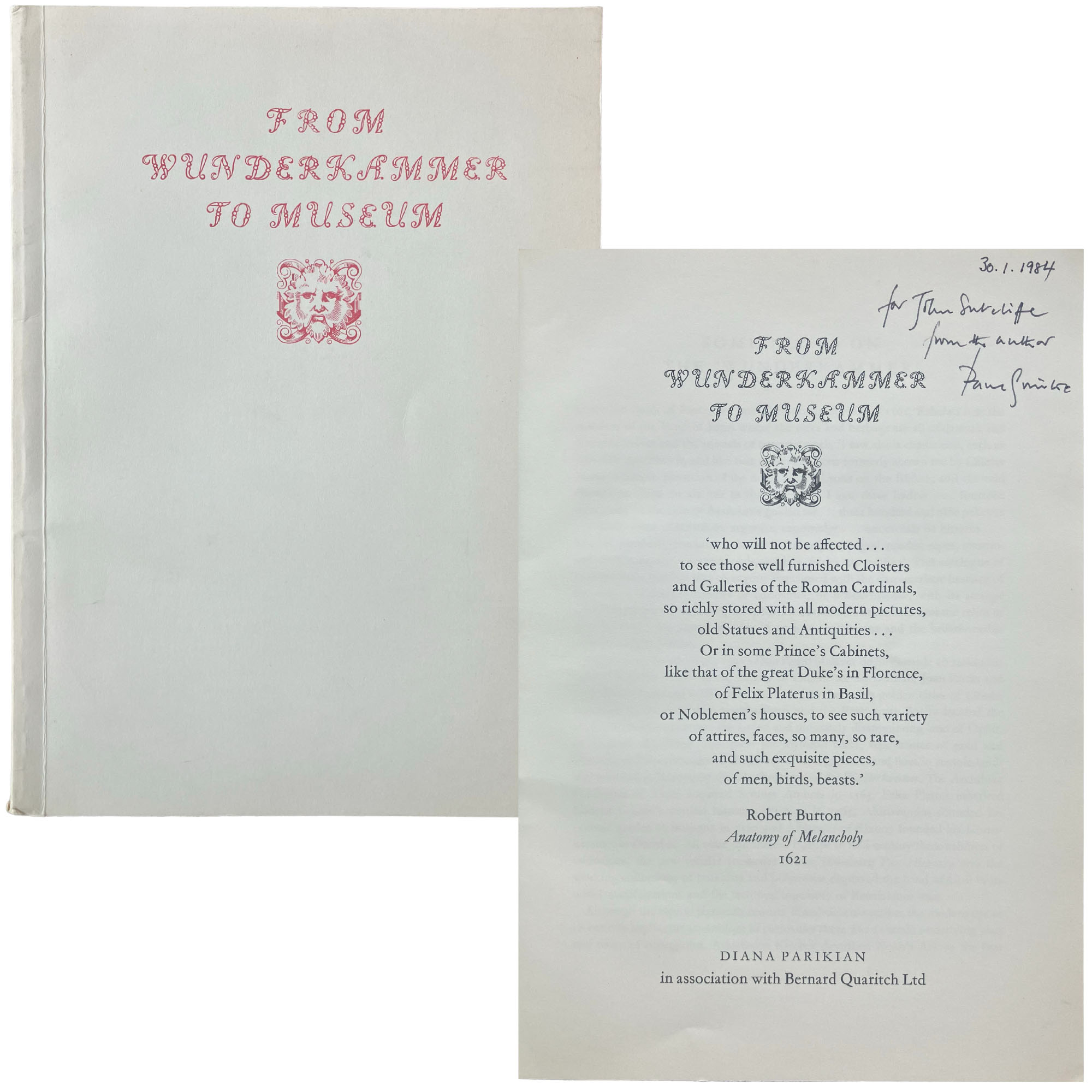
From Wunderkammer to Museum, compiled by P.Grinke
London, United Kingdom: Diana Parikian and Bernard Quaritch Ltd., 1984
Description: GRINKE, Paul (1984), From Wunderkammer to Museum. Diana Parikian and Bernard Quaritch Ltd., 82 pp. Publisher's printed softcover, as issued; inscribed "30.1.1984, for John Sutcliffe, from the author, Paul Grinke."" The 1984 edition is considered rare. Harrison (2008) notes that it was "originally published in a very small edition, distributed to the handful of wealthy institutions to which the vendors hoped to sell the collection en bloc," a statement confirmed in the second edition of the catalogue, where it is described as having been "printed in very small numbers" (Grinke, 2006:12). According to a review in The Book Collector, Spring 1985, p. 97: "The customers who received this... were fortunate indeed. Only a few were printed... we understand that there are simply no more to be had." The present copy, inscribed by Paul Grinke, is thus of particular interest, all the more so given that the work itself is "something of a pioneer catalogue in a field now much studied" (Grinke, 2006:12).
Select a thumbnail to view its caption.
Spectacle, Curiosity & Dime Museums of the 19th Century
TEXT COMING LATER
COMING LATER
Studies & Stories of Collecting in the 19th Century
TEXT COMING LATER
COMING LATER
Paul Eudel (1837-1911) was one of the great French collectors, bibliophiles, and art critics of the second half of the 19th century. He wrote prolifically on the culture of collecting, notably in his 1885 anthology Collections et Collectionneurs, which brings together eight stories illustrating an exceptional breadth of interests. Few of his contemporaries ranged so widely: his subjects include artworks, toys, sporting memorabilia, pipes, stamps, marionettes, and shells, reflecting a curiosity that transcended conventional boundaries. He also published studies on individual collectors and on forgeries, as well as fictional works set within the world of collecting, among other topics. Eudel himself assembled diverse collections of artworks, books, and engravings, documented in several sale catalogues (Drouot, 1895-1898). He also formed a distinguished collection of silverware (Eudel, 1884) and a remarkable ensemble of collection catalogues. While such catalogues were fashionable during the Belle Époque, Eudel described his own as "almost unique," notably organised through a system of colour-coded bindings: red for engravings, blue for autographs, brown for artworks, yellow for paintings, jaspé for ceramics, and black for books (Drouot, 1895: xi). His little museum was claimed to be second only to the collection of Baron Pichon. The extraordinary diversity of both his collections and his writings places Eudel at the heart of the culture of collecting during a transitional period marked by increasing specialisation, yet also by an unprecedented proliferation of objects and fields of interest. His work and practice thus retain the spirit of the Cabinet of Curiosities, embracing multiplicity rather than narrowing focus.
See also, in the Gallery of Natural History Collections:
• The Shell Field-Collection of Émile Eudel (which includes Paul Eudel's author
copy of Journal de Bord de mon frère Émile, 1897)
- DROUOT (1895), Bibliothèque P. E., Catalogue de Livres Rares et Curieux et d’Affiches Illustrées. Paris: Léon Sapin, 73 pp.; DROUOT (1898), Catalogue de la Bibliothèque de M. Paul Eudel, Première Partie. Paris: E. Paul et Fils et Guillemin, 178 pp.; DROUOT (1898), Catalogue de la Bibliothèque de M. Paul Eudel, Deuxième Partie. Paris: E. Paul et Fils et Guillemin, 30 pp. [in coll.: Bound together in bradel binding, retaining their covers]
- EUDEL, Paul (1884), 60 planches d'orfèvrerie de la Collection de Paul Eudel, pour faire suite aux Eléments d'orfèvrerie composés par Pierre Germain. Paris: Quantin. Engravings (drawn by Adolphe Giraldon and engraved by Dujardin) in portfolio [in coll.: CHAMPFLEURY COPY - Portfolio chipped, one of 400 copies, in-4. Presented to "excellent maître et ami Champfleury". Referred in Champfleury's sale catalogue (1890:lot 738)]
- EUDEL, Paul, l'abbé de Cagny, G., Gosselin, P., d’Ournel, J. (1885), Généalogie de la famille Eudel, dressée en 1884. Dijon: Imprimerie Darantière, privately printed for Paul Eudel, 29 pp. [in coll.: Original wrapper, some wear to spine and corners, uncut. Very rare edition of 26 copies, here number 7. ASSOCIATION COPY, presented by Paul Eudel to his wife Elisa, signed twice and inscribed "Cette brochure a été imprimée à mes frais et tirée à 26 exemplaires seulement. No. 7, Paul Eudel | exemplaire offert à ma chère Eliza devenue madame Eudel depuis le 4 janvier 1864, Paul Eudel"]
Unique Volumes of Some of Eudel's Writings on the Collecting Process, from His Library Sold in 1913
_binding.jpg)
_binding.jpg)
_titlepage.jpg)
(i) AUTHOR COPY - Trucs & Truqueurs..., by Paul Eudel
Paris: Librairie Molière, 1908
Description: EUDEL, Paul (1908), Trucs & Truqueurs. Altérations, Fraudes et Contrefaçons dévoilées. Paris: Librairie Molière, 579 pp. In two volumes in-8, beautiful binding, full red morocco, gilt edges, signed by Chambolle-Duru. One of three copies on Japan paper, No. 1. Eudel's gilt armorial stamp on both covers - A tour de force by the author, offering a comprehensive overview of famous fraudulent collectibles, from the Lying Stones of Professor Béringer to L'Assiette à la guillotine of Gouellain. Forgeries described include prehistoric and archaeological artifacts, silverware, paintings, engravings, ceramics, bookbindings, autographs, and musical instruments, among others. Notorious forgers, such as Becker (18th century, coins) and Hagué (19th century, book bindings) are also mentioned. The section on counterfeits at the Saint-Germain museum, as well as ways to recognise forgeries, are also discussed.
(ii) AUTHOR COPY - Entre Collectionneurs, by Paul Eudel
Paris: E. Dentu, 1888
Description: EUDEL, Paul (1888), Entre Collectionneurs. In: Nos Cinquante Ans, Récits, contes et nouvelles, pp. 219-227. Paris: E. Dentu, 497 pp. In-12 Bradel gray percaline binding, untrimmed, with covers preserved. Eudel's gilt armorial stamp in the centre of the upper cover. Copy enriched with twenty autograph signatures on the front endpaper - 31 short stories including the one on collectors by Eudel. It recounts the story of a group of collectors discussing a rare coin exchange made by one of them. The main character, eager to acquire a coveted coin, crafts a fake medal to deceive another into parting with it. The tale concludes with an unexpected twist regarding the coin's true origin.
Provenance: Paul Eudel
References: Eudel sale catalogue (1913: (i) lot 150; (ii) lot 355)
Select a thumbnail to view its caption.
The 1885 'Collections et Collectionneurs' Correspondence Archive, a Unique Resource on Collecting Culture
_varia.jpg)
_shellmanuscript.jpg)
Correspondance, Collections et collectionneurs, avant et après
Paris: Unpublished material, c. 1885
Description: Unique archive accumulated by Paul Eudel relating to the preparation and publication of his Collections et Collectionneurs
book (see below). Bound volume dated 1885 with over 80 letters and a manuscript on shell collecting by his brother Émile, handwritten, some with
envelopes. Among the letters contained in this precious archive are some from Arthur Maury, one of the pioneers of philately and
author of the first stamp-collecting catalogues, from Arsène Vigeant, collector of fencing memorabilia, from Ad. Giraldon regarding
the toy collection of Mme. Agar; from faience collector Gustave Gouellain, to whom Eudel dedicated Collections et Collectionneurs,
others from the printing firm of P. Charaire et fils, who printed the work for publisher G. Charpentier, and many more from other philatelists
and shell collectors. Short thank-you letters and other compliments for the publication of the book come from Baronne Davillier, widow of Baron
Jean-Charles Davillier, Baron Pichon, Champfleury, and Edmond Bonnaffé to only cite some of the most famous. The manuscript on shell collecting by
Eudel’s brother Émile gives many details about shell collecting (books for browsing or to buy, characteristics/psychology of the collector, common
& rare types of shells, famous collections & great collectors, treatment/improvement of shells, dealers, prices, field collecting, publications).
Valuable information also comes from Edouard Auguste Marie (1835-1888), French malacologist. In an 11-page letter, Marie replies to Eudel's
request for information "on the most important conchological collections and the value of the rarest shells."
Accompanied with: EUDEL, Paul (1885), Collections et collectionneurs. G. Charpentier et Cie., Paris, 300 pp. Modern binding, one of only
two copies printed on rose-colored paper, with Eudel's signed autograph inscription on the title verso: "Il a été tiré sur papier rose deux
exemplaires qui n'ont pas été mis dans le commerce. Paul Eudel. No2".
Provenance: Paul Eudel
Select a thumbnail to view its caption.
Encyclopedic Cabinets & Compendia on Collecting in the Enlightenment
TEXT COMING LATER
"Few men have equaled Margaret Cavendich Holles Harley (1714-1785), Duchess of Portland, in the mania of collecting, and perhaps no woman. In an age of great collectors she rivalled the greatest."
W.S. Lewis in The Dutchess of Portland's Museum, 1936:v
.jpg)
Fig. 1. The celebrated frontispiece of the 1786 auction catalogue, depicting the Portland Vase (now at the British Museum) alongside other rarities. Through the use of an imaginary mirror, the composition presents the famous vase from both sides.
Margaret Cavendish Holles Harley, Duchess of Portland (1715-1785), one of the wealthiest women in 18th-century England, was a distinguished patron of naturalists and explorers who assembled one of the greatest private museums of her age at Bulstrode Park, Buckinghamshire. During her lifetime, her house, known in court circles as The Hive, became a place of wonder, intellectual curiosity, and philosophical speculation (Stott, 2006). Her collection of shells and other natural specimens was regarded as the finest in England and rivalled the best in Europe (e.g. Dance, 1986). Today, the Duchess is perhaps best remembered for the celebrated Barberini-Hamilton Vase, which came to bear her name as the Portland Vase (Fig. 1). Although the greater part of her museum consisted of natural history and mineral specimens, including extensive gardens and a menagerie, she also collected books, paintings, busts, coins, medals, miniatures, jewels, and porcelain (Walpole, 1936:vi). The foundation of her collection came through inheritance, principally from her father, Edward Harley, 2nd Earl of Oxford. While much of his magnificent library (itself partly inherited from Robert Harley, 1st Earl of Oxford), works of art, curiosities, and other rare objects, together with his estates, was dispersed to satisfy debts, Margaret inherited his remarkable collection of Hollar prints as well as a rich cabinet of rarities. The Duchess naturally inherited her family's passion for collecting and was probably further inspired by witnessing the decline and dispersal of the collections assembled by her father and grandfather. Her early interests centred chiefly on shells, japan & old china. Later in life, she devoted herself increasingly to natural history, while continuing to acquire paintings and other objects that appealed to her taste. Only a few years before her death, she engaged the Swedish botanist Daniel Solander, a pupil of Linnaeus, to arrange and catalogue her shells, fossils, insects, and other natural specimens. Her final and most celebrated acquisition, made only a few months before her death, was the Barberini Vase, imported into England by Sir William Hamilton (the vase was probably made in Rome during the reign of the first emperor Augustus (27BC-14AD), and had been in the Barberini Palace, Rome in 1642; Johnson, 1999). Following the Duchess's death in 1785, it was discovered that her estate was heavily in debt, and her collection was consequently ordered to be auctioned. The celebrated sale took place over thirty-eight days in 1786 and excluded several of the most valuable objects, including enamels, miniatures, her finest jewels, and selected paintings and other precious works of art. Sadly, the Portland Museum survives today only in fragments following the dispersal of this extraordinary collection (Walpole, 1936; Stott, 2006; Johnson, 1999).
The catalogue of the 1786 sale is an extraordinary document, providing the most detailed surviving record of the Portland Museum. It also represents part of the ambitious classification project undertaken by the Duchess in collaboration with her curator and chaplain, John Lightfoot, and Dr Solander, a project begun in the 1760s (Stott, 2006). In the sale catalogue, Lightfoot explained that the museum remained unfinished because of the grand ambition "of the enlightened possessor to have had every unknown species [of shell] described and published to the World", an undertaking ultimately brought to an end by the deaths of both Solander and the Duchess. The provenance of the specimens listed in the catalogue illustrates the global reach of British exploration during the 18th century. The importance of the shell collection was emphasised by Peter Dance in his History of Shell Collecting (1986:73-76), who highlighted that many of these specimens had been collected during Captain Cook's first voyage and were presented to the Duchess in 1771.
- REHDER, Harald A. (1967), Valid Zoological Names of the Portland Catalogue. Washington: Smithsonian Press, Proceed. U.S. Nat. Museum, 121 (3579), 47 pp. [in coll.: Offprint with original wrappers, inscribed "with best wishes, Harold A Rehder"]
- STOTT, Rebecca (2006), Duchess of Curiosities. The life of Margaret, Duchess of Portland. Welbeck: The Pineapple Press, 44 pp. [in coll.: softcover, as issued] - Published for The Harley Gallery to complement the exhibition Duchess of Curiosities. The life of Margaret, Duchess of Portland, which opened in March 2006.
- WALPOLE, Horace (1936), The Dutchess of Portland's Museum. With an Introduction by W.S. Lewis. Windham: Hawthorn House. The Grolier Club, xii, 15 (2) [in coll.: One of 450 copies printed. Includes the presentation card of The Grolier Club, as well as a typed letter dated 23 November 1973 signed Wilmarth S. Lewis to Stanley Marx with "The Lewis Warpole Library" letterhead] - Wilmarth Sheldon Lewis (1895-1979) devoted much of his life to collecting Horace Walpole's writings, correspondence, and related artefacts. His lifelong pursuit culminated in the founding of the Lewis Walpole Library at Yale University in Farmington, Connecticut. Lewis owned Walpole's personal copy of the Portland Museum sale catalogue, into which Walpole had bound his account of the Duchess on "four sides of a quarto sheet", the manuscript reproduced here. Horace Walpole (1717-1797), a friend of the Duchess, was also a great collector.
The Definitive Catalogue of One of Britain's Greatest 18th-Century Collections, this Copy Numbered 1224, the Highest Recorded by Johnson
_titlepage.jpg)
_pricelist.jpg)
A Catalogue of the Portland Museum... & A Marked Catalogue...
London: Various, 1786
Description: LIGHTFOOT, John (1786), A Catalogue of the Portland Museum, lately the property of the Duchess Dowager of Portland, Deceased: which will be sold by auction, by Mr. Skinner and Co. On Monday the 24th of April, 1786, and the thirty-seven following days, at twelve o’clock, Sundays, and the 5th of June (the day his majesty’s birth-day is kept) excepted; at her late dwelling-house, in Privy-Garden, Whitehall. By order of the acting executrix. London: Skinner and Company. [Bound with] LIGHTFOOT, John (1786), A Marked Catalogue containing the Lots, what each respectively sold for, and the Names of the Purchasers of the four thousand two hundred and sixty-three lots which constituted the Portland Museum. London: Kearsley, Walker, Sewell, Flexney, Robson and Egerton. Wunderkammer frontispiece; title page, viii, 3-194 pp.; Title page, 5-44 pp. 4to (25.0 x 20.2 cm). The two works in one, number 1224. Mid-20th-century dark blue buckram with gilt title on the spine. Stamped "RICHARD I. JOHNSON" on title page. Accompanied with two offprints: (i) DANCE, S. Peter (1962), The Authorship of the Portland Catalogue (1786). Reprinted from the J. Soc. Biblio. Nat. Hist., 4 (1), pp. 30-34, with a handwritten dedication by Dance to Johnson; (ii) JOHNSON, Richard I. (1999), The Duchess, the Brahmin, and the Chank Shell. Dept. Mollusks, Museum of Comparative Zoology, Harvard University, Cambridge, 6 (78), pp. 67-81 (where this specific numbered copy of the Portland catalogue is referred to). Includes some additional clippings from a 1949 article about the Portland Vase published in The Illustrated London News (mentioned in Johnson, 1999) - The catalogue describes 4,156 lots, the majority consisting of naturalia (including shells, corals, minerals, fossils, insects, birds, birds' eggs, and plants) as well as a remarkable range of artificialia, (japan and china, Indian curiosities, coins and medals, snuff boxes, prints and drawings, crystal models, jewels, and antiquities).
Provenance: Richard Irwin Johnson
References: Johnson (1999), who notes that "Copies of The Catalogue were numbered, 1224 being the highest I have seen" (the number borne by the present copy).
Select a thumbnail to view its caption.
"The Dávila catalog (as it has become known) describes 8,096 mineral specimens that encompass a large range of localities [...]. In addition, the catalog lists 5,253 shells, 600 preserved animals, 101 plants, 3,915 fossils, 154 bezoars and calculi, and 402 books. Over 12,000 prints and engravings, 1,741 original artworks, 441 maps, as well as various scientific instruments and precious stones are also described. Thus Dávila's collection was certainly one of the largest ever formed, and a major auction event of the 18th century."
Curtis Schuh, Schuh's Annotated Bio-Bibliography, 2007
Pedro Francisco Dávila (1711-1786) was a naturalist and passionate collector who assembled one of the greatest collections ever formed by an individual. His cabinet was particularly renowned for its fine minerals and natural history specimens, but it also encompassed works of art, cultural artefacts, books, and scientific instruments. Born in the Viceroyalty of Peru into a wealthy Spanish family of traders, particularly in cocoa and beans, Dávila entered the family business at the age of fifteen. His early career took him on an adventurous life at sea around Panama, during which he survived a shipwreck, yellow fever, and captivity. In 1748, he moved to Paris, where he discovered the world of collecting and immersed himself in the study of natural history. For Dávila, this discipline extended beyond the natural world to include art, which he regarded as "adding a new lustre and a new merit" to the materials of Nature. For the next twenty years, Dávila devoted himself almost entirely to collecting. By 1767, however, he had accumulated debts of 300,000 reales through his extravagant purchases of specimens. Pressured by his creditors, he was forced to liquidate his collection and prepare it for auction (Wilson, 2006). A detailed catalogue was essential for this purpose. Dávila had already written numerous descriptions of his specimens, but his introduction to Jean-Baptiste Romé de l'Isle resulted in a remarkable record of the collection: the highly regarded 1767 catalogue. According to Schuh, the principal strength of Dávila's cabinet lay in its superb mineral specimens, many of which were exceptionally well crystallized. Its historical importance was further enhanced by specimens acquired from earlier celebrated collections, including that of Albertus Seba, auctioned in 1752. Dávila's catalogue was widely distributed in Paris, London, Amsterdam, Rotterdam, and Basel, although good copies are now scarce (Wilson, 2006). The catalogue helped generate total auction proceeds of more than 800,000 Spanish reales, far exceeding the amount necessary to satisfy Dávila's creditors and leaving him with sufficient capital to begin building a second collection. Within two or three years, he had once again assembled a substantial cabinet, this time with a particular emphasis on minerals selected with the greater knowledge and experience he had acquired through his first collecting campaign. Dávila again dreamed of establishing his cabinet in Madrid, an ambition that had remained unrealized with his first collection. In October 1771, this finally became a reality when King Carlos III agreed to acquire his collections, appointing Dávila as their director for life (Schuh).
A Precious Copy of the 1767 Catalogue of the Dávila Cabinet, a Detailed Insight into "Certainly One of the Largest Ever Formed"
_plate.jpg)
_binding.jpg)
_titlepages.jpg)
Catalogue [...] des Curiosités [...] qui composent le Cabinet de M. Dávila
Paris: Briasson, 1767
[From Wunderkammer to Museum #12]
Description: ROMÉ DE L’ISLE, J. B. L. and Abbé DUGUAT (1767), Catalogue systématique & raisonné des Curiosités de la Nature & de l’Art, qui composent le Cabinet de M. Dávila. Paris: Briasson, Three volumes. [36], 571; [6], 656; [6], 290, 286, [1] pp., 30 engraved plates (some folding). Contemporary half calf and marbled boards, spines in six compartments with raised bands, ruled and lettered in gilt, with armorial crests in two compartments, red edges, round ink stamp "Classenske Bogsamling" ("Bogsamling" meaning "book collection" in Danish) and "RICHARD I. JOHNSON" stamp on title page. The bottom coat of arms is believed to be from J.F. Classen (based on comparison to other books from the Classen library) - Described by Schuh as very scarce, this catalogue provides a remarkable insight into the Dávila collection, as well as into his particular tastes and preferences as a collector. Romé de l'Isle took Dávila's existing material and substantially expanded the mineralogical descriptions, bringing the catalogue into publishable form. He was assisted by Abbé Duguat, who contributed to the mineralogical descriptions, and Abbé Gua de Malves, who described the shells. Their efforts resulted in two volumes devoted to natural history specimens, one of them entirely dedicated to minerals. A third volume, written by Romé de l’Isle, probably with the assistance of Pierre Remy, described the fossils, works of art, and books in the collection (Schuh).
Provenance: Johan Frederik Classen • ... • Richard Irwin Johnson - Johan Frederik Classen (1725-1792) was a Danish-Norwegian industrialist, major general and landowner. He amassed a large library.
Select a thumbnail to view its caption.
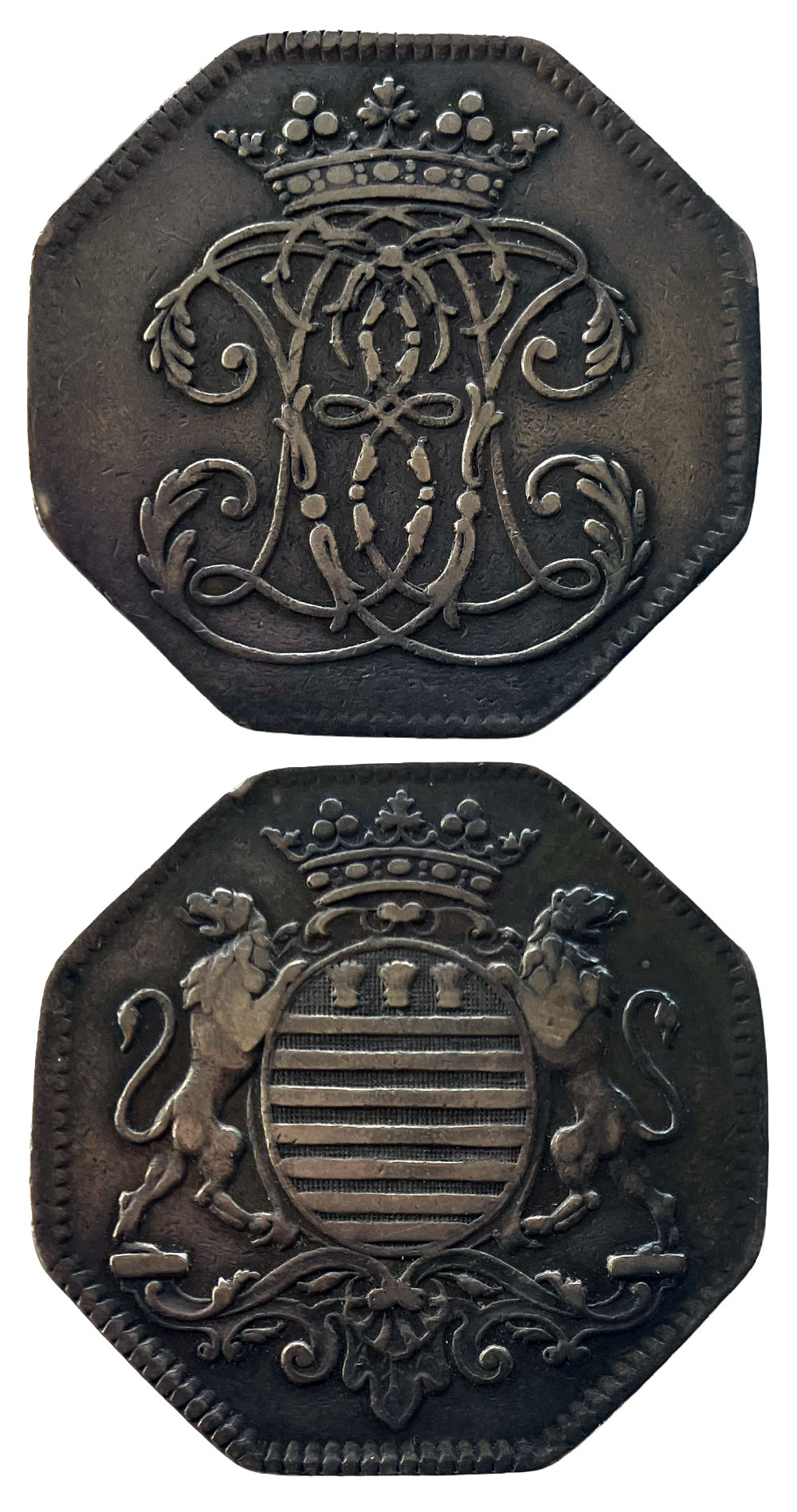
Silver armorial jeton of Bonnier de la Mosson, octagonal, bearing his crowned cipher on the obverse and his coat of arms on the reverse.
Joseph Bonnier de la Mosson (1702-1744), who inherited both a considerable fortune and the post of Trésorier of Languedoc upon his father's death in 1726, was uniquely positioned to indulge his passion for collecting during his short adult life, which was prematurely ended by accident. It was in the Hôtel du Lude in Paris, also inherited from his father, that Bonnier de la Mosson created one of the greatest collection cabinets of the Ancien Régime, remarkable for both its size and scope, at a time when interest in natural history was beginning to eclipse the traditional focus on antiquities. Bonnier de la Mosson assembled an extensive natural history collection, alongside collections of scientific instruments and objects related to physics, chemistry, pharmacy, and engineering. He also maintained an art collection and a library. Altogether, these were displayed across seven interconnected rooms on the first floor of his hôtel particulier. Today, the cabinet is primarily known through scholarly studies based on surviving illustrations and catalogues. His collections exemplify the transition from the Renaissance Wunderkammer (see below) to the systematically organized, scientifically oriented cabinets of the Enlightenment. The first catalogue of the collection was published in Paris in 1737, seven years before his death, as a small duodecimo volume of 64 pages prepared by Edme François Gersaint, the prominent dealer and cataloguer of the period. Immediately following Bonnier de la Mosson's death in 1744, Gersaint was commissioned by the family to produce a second, expanded catalogue of 234 pages in octavo format to facilitate the sale of the collection. The descriptions provided in the 1744 catalogue demonstrate why it was considered one of the most renowned collections of both natural history specimens and scientific instruments (Schuh's Bibliography).
The Very Rare Catalogue of One of The Finest Parisian Cabinets, With Some Prices & Buyers' Names
_frontispiece.jpg)
_inside.jpg)
Catalogue raisonné d'une collection considerable..., by E.-F. Gersaint
Paris: Jaques Barois & Pierre-Guillaume Simon, 1744
[xxx]
Description: GERSAINT, Edmé-François (1744), Catalogue raisonné d'une collection considerable de diverses curiositiés en tous genres, contenues dans les cabinets de feu Monsieur Bonnier de la Mosson. Paris: Jaques Barois & Pierre-Guillaume Simon, 234 pp., with Avis and Errata sheet. Title-frontispiece after Boucher reused with modified text (print in third state of three). Fine French contemporary marbled calf, spine richly gilt, in compartments, ruled in red. Many prices and buyers'names penned to the margins in a fine hand - "Very rare [...] This sale catalog lists 966 lots with brief descriptions, including illustrated books and works of art. Among the different sections of the scientific collections may be mentioned the following: Cabinet d'Anatomie (pages 1-4), Cabinet de Chimie ou Laboratorie (pages 5-16), Cabinet de Pharmacie (pages 11-18), the natural history cabinet containg mostly minerals (pages 54-82), and the Cabinet de Mécanique et de Physique (pages 83-172), in which 222 scientific instruments and machines are listed and described in detail, including descriptions of many microscopes and a whole treatise on telescopes (pages 116-20)." (Schuh's Bibliography). The frontispiece engraving, with shows shells and corals in the foreground and three shelves of bottled, preserved anatomical and animal specimens in the background [Wilson 16], was reproduced from the earlier 1736 Gersaint catalogue.
Select a thumbnail to view its caption.
'Le Miroir des Urines', a Fitting Book for a Cabinet of Curiosities, From the Bonnier de la Mosson Library
_binding.jpg)
_titlepage.jpg)
Le Miroir des Urines..., by J. Davach de la Rivière
Paris: Cavelier, Delaguette, 1696
Description: DAVACH DE LA RIVIÈRE, Jean (1696), Le Miroir des Urines par lesquelles on voit & connoit les differens temperamens, les humeurs dominantes, les sieges & les causes des maladies d'un chacun. Paris, 337 pp. Rare first edition, including the privilege (signed by the author) and errata. Contemporary calfskin binding with a gilt-stamped spine label and richly decorated floral gilt tooling on the spine; old repair to the upper headcap, rear joints cracked, corners worn. The binding features the gilt-stamped coat of arms of Bonnier de La Mosson on the front cover and the gilt-stamped name "Mr. Bonnier de La Mosson" on the back cover. With a handwritten previous ownership note on the inside cover: "Ce present livre ajetté a Paris le premier mai 1721. il couste 6₶ [livres] il appartient au Sieur Thierry, chirurgien a Donzy."
Provenance: Joseph Bonnier de la Mosson (after 1721-1745)
References: Library sale catalogue (1745:lot 432)
Select a thumbnail to view its caption.
COMING LATER
Illustrated Catalogues of Renaissance Wunderkammern
Cabinets of Curiosities, or so-called Wunderkammern, were assemblages of naturalia, exotica, artificialia, and scientifica which, combined in an eclectic manner, created an atmosphere that exceeded the sum of their individual parts. They flourished in Europe during the sixteenth and seventeenth centuries, in the context of early modern exploration, and declined in the eighteenth century with the rise of Enlightenment rationalism (see above). Many Cabinets of Curiosities were assembled by apothecaries, physicians, and other scholars who sought to study the objects they collected. At the same time, these collections served as sources of pleasure and as status symbols, celebrating the wealth, erudition, and intellectual authority of their owners. Members of the nobility likewise assembled such cabinets, frequently through the acquisition of pre-existing collections, as exemplified by Peter the Great.
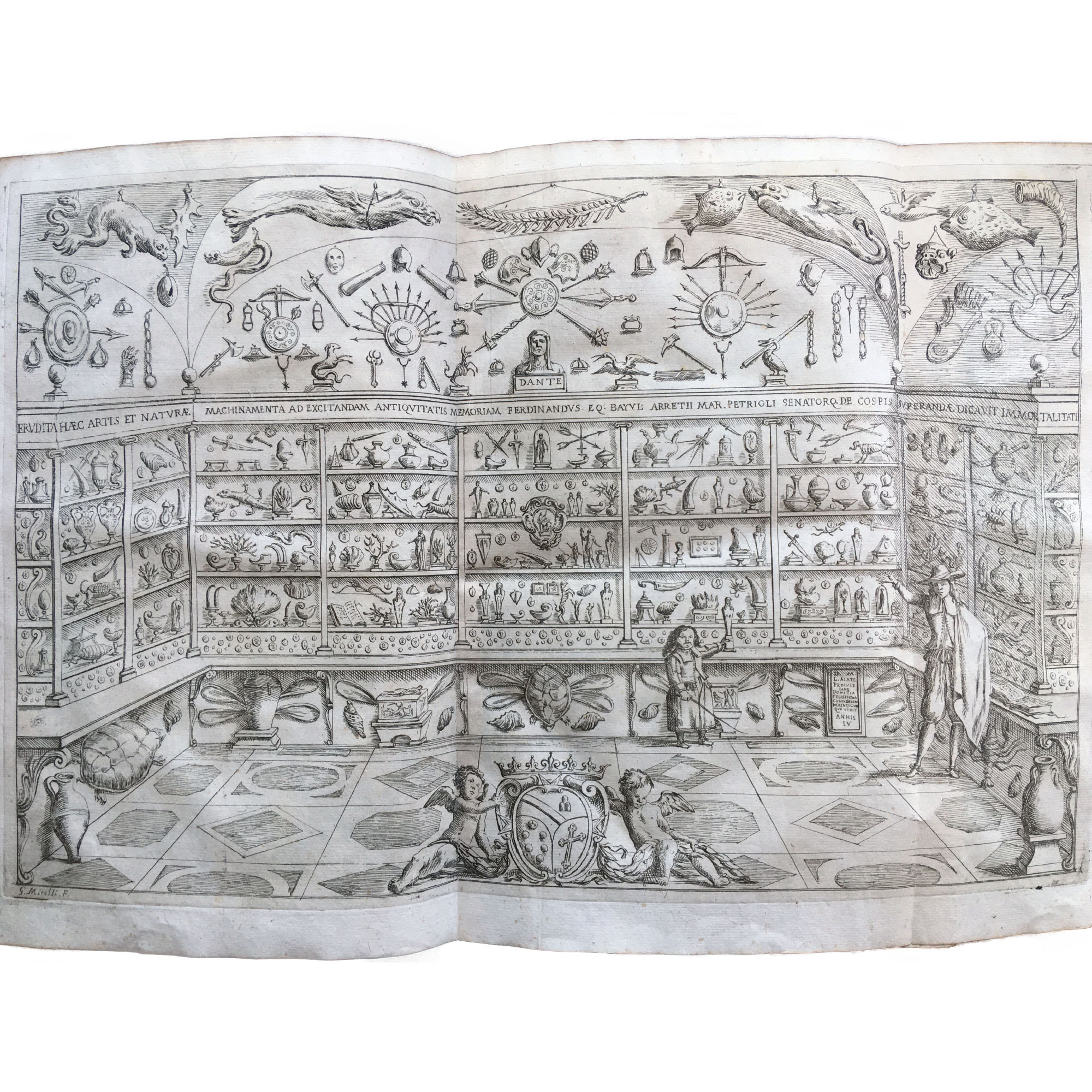
Renaissance Cabinets of Curiosities have entered the modern imagination chiefly through engraved views of their collections, frequently issued as double-page foldouts in contemporary catalogues. What strikes the modern viewer is the densely packed and eclectic arrangement of naturalia and artificialia within a single space, frequently incorporating chimeras, legendary creatures, and mystical objects. Items are usually crowded into every corner and, characteristically, suspended from the ceiling. The reader of such catalogues is at once overwhelmed and compelled to scrutinise each depicted object. On closer inspection, however, a form of order emerges: objects are often grouped according to a discernible, if idiosyncratic, logic. Only a small number of such Wunderkammer depictions exist. The most celebrated include those of Ferrante Imperato (1599), Francesco Calceolari (1622), Ole Worm (1655), and Ferdinando Cospi (1677).
Nicolas Chevalier (1661-1720), of the Reformed faith, was forced into exile in Holland following the Revocation of the Edict of Nantes. There he became a bookseller, printer, and engraver of medals, and published several learned dissertations. He dedicated his work to Jacob de Wilde, auditor of the Admiralty of Amsterdam and a noted collector. While in Holland, Chevalier assembled a collection of rarities that may be divided into three distinct Cabinets of Curiosities, corresponding to different periods and locations in his life: Amsterdam (1685-1703), Utrecht (1703-1716), and Amsterdam again (1716-1720). Although Chevalier's catalogues are rarely mentioned in studies of Wunderkammern, they contain fine engravings depicting the various sections of his collection, exemplifying the exotic wonders that reached Holland during the Dutch Golden Age.
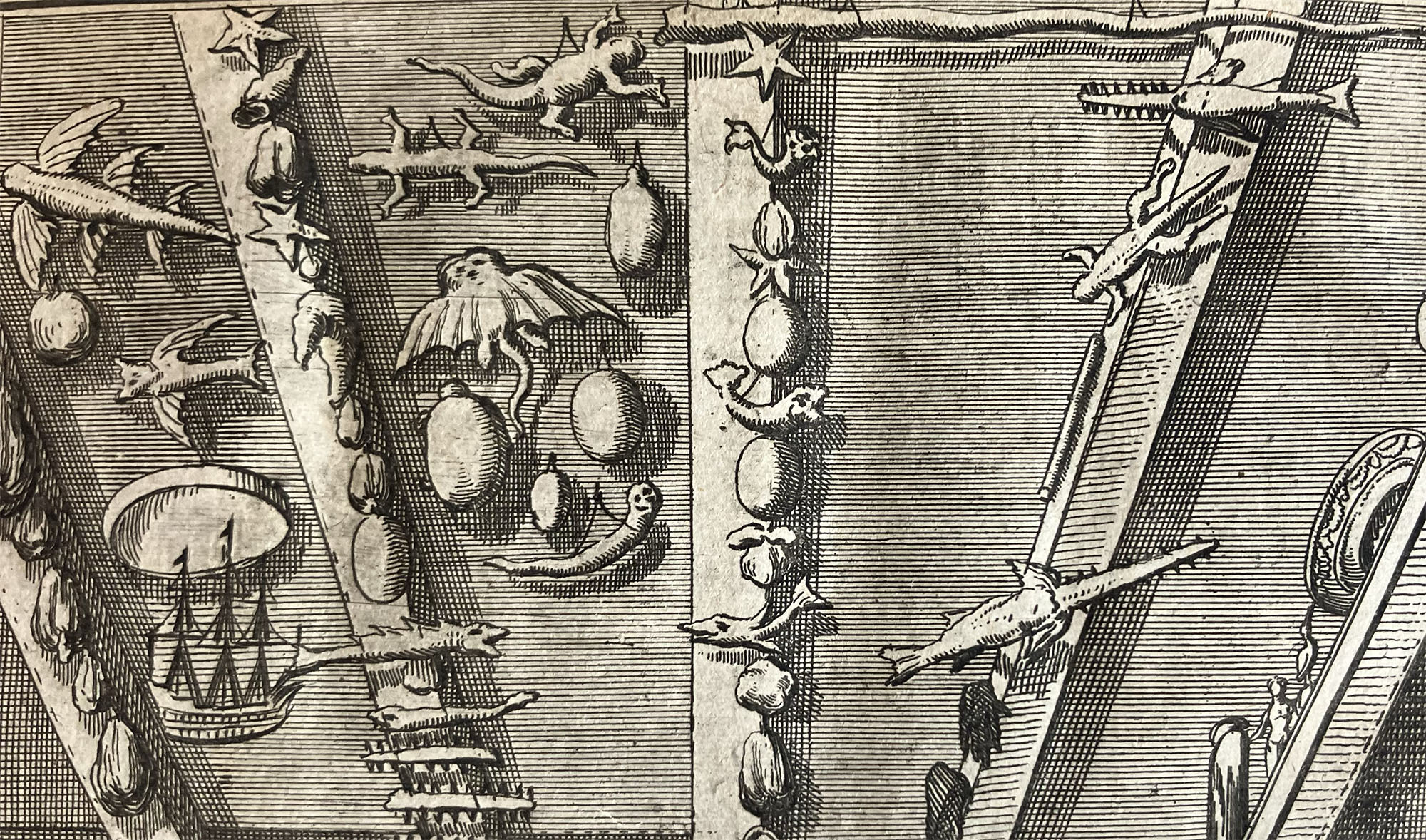
...
Rare Catalogue of the First Cabinet of Rarities of Nicolas Chevalier
.jpg)
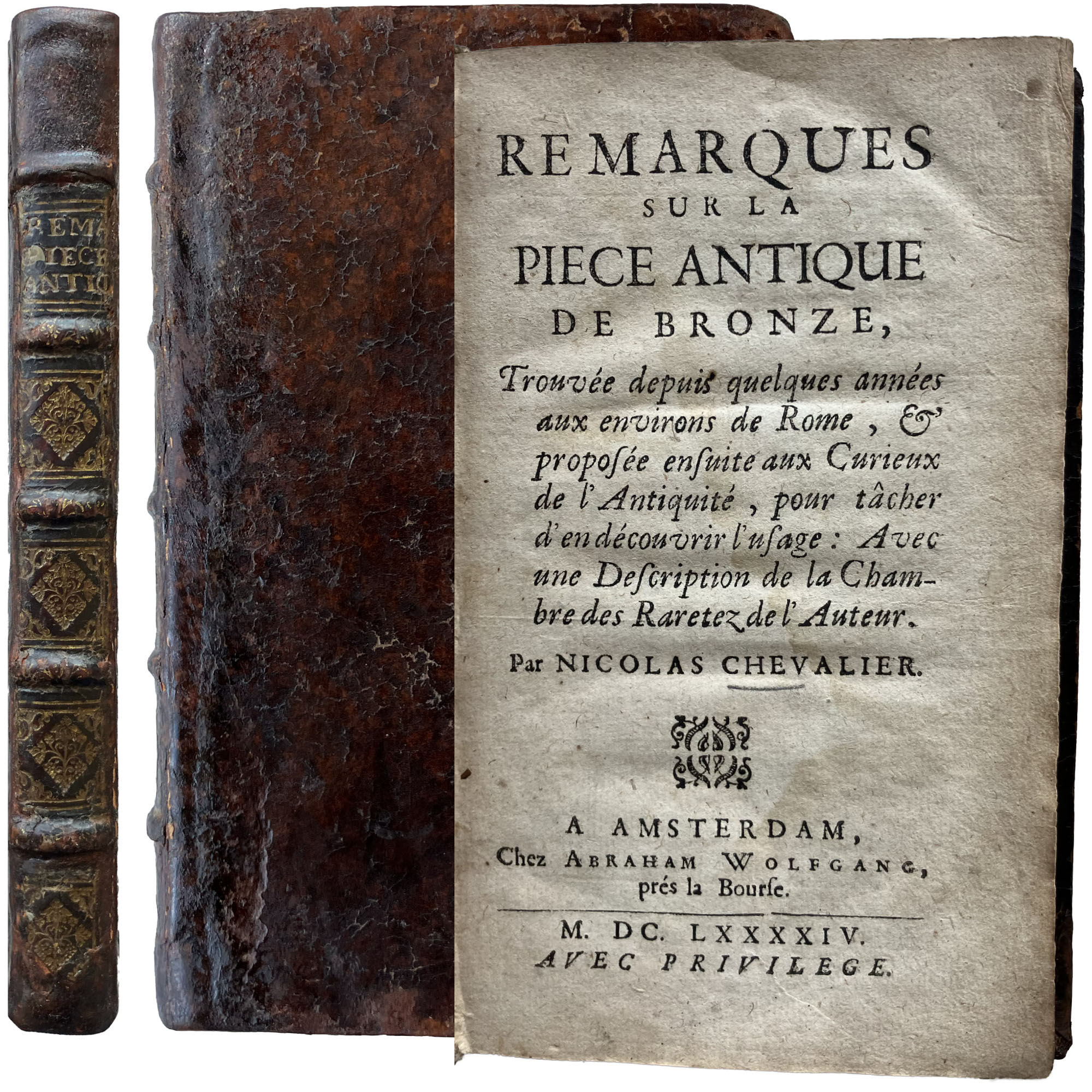
.jpg)
... Description de la Chambre des Raretez de l'Auteur
Amsterdam: Abraham Wolfgang, 1694
[Cabinets de Curiosités... #87]
Description: CHEVALIER, Nicolas (1694), Remarques sur la Pièce Antique de Bronze, Trouvée depuis quelques années aux environs de Rome, & proposée ensuite aux Curieux de l'Antiquité, pour tâcher d'en découvrir l'usage : Avec une Description de la Chambre des Raretez de l'Auteur. Amsterdam: Abraham Wolfgang, frontispiece, [10] ff., 138 pp., 14 copper-engraved plates, 3 folding plates. In-12, dark brown grained calf binding, restored, spine with raised bands and ornamentation, red-speckled edges. A few very faint water stains. One folding plate lacking - The present catalogue, describing his first cabinet, includes a list of objects and is magnificently illustrated of engravings showing the walls and ceiling of his collection displays. His cabinet contains coins and medals, along with the tools necessary for their striking; antiquities; a curious cabinet of amber; ethnographic weapons; exotic animals; unicorn horns, and more. Most of these marvels can be seen in the fine engraved plates.
Select a thumbnail to view its caption.
Marchese Ferdinando Cospi (1606-1686), a Bolognese senator and purchasing agent for the Medici family, assembled a large collection of natural curiosities. He donated it for the use of scholars to the city of Bologna in 1657; it was formally bequeathed in 1672 and housed in an annex to Aldrovandi's museum in the Palazzo Pubblico. Ulisse Aldrovandi (1522-1605), often regarded as the father of natural history, had earlier willed his vast collections in botany and zoology to the Senate of Bologna. These were opened to the public in 1617, making them among the earliest examples of a private scholarly collection becoming publicly accessible. The two collections, later merged, were described by Lorenzo Legati (c. 1605-1675) in a celebrated Wunderkammer catalogue. As the catalogue focused primarily on Cospi's collection, the more encyclopedic and scientific character of Aldrovandi's holdings was somewhat obscured, while Cospi's different ambition, that of the Wunderkammer, emerges clearly in the engraving of the museum's interior. The Aldrovandi and Cospi collections were nonetheless complementary, the latter contributing significant artificialia to what had been a predominantly naturalia-focused assemblage. In 1743, a large portion of the collection was transferred to the Istituto delle Scienze, which was later incorporated into the Museo Civico di Bologna in 1871.
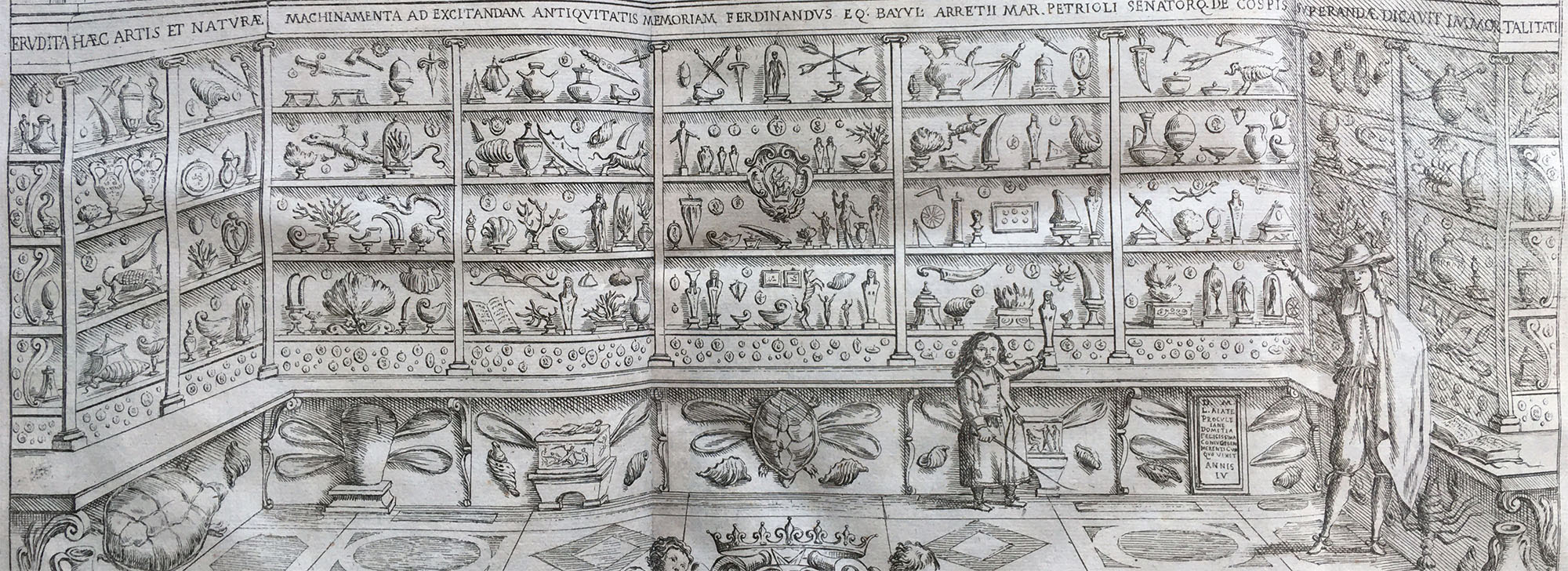
The dwarf Sebastiano Biavati, a living member of the collection, stands alongside Ferdinando Cospi before the Cabinet of Curiosities, presenting it to the reader of the Wunderkammer catalogue.
Museo Cospiano, One of the Most Emplematic Depictions of a Wunderkammer Interior
Museo Cospiano annesso a quello del famos Ulisse Aldrovandie...
Bologna: Giacomo Monti, 1677
[From Wunderkammer to Museum #25][Cabinets de Curiosités... #97]
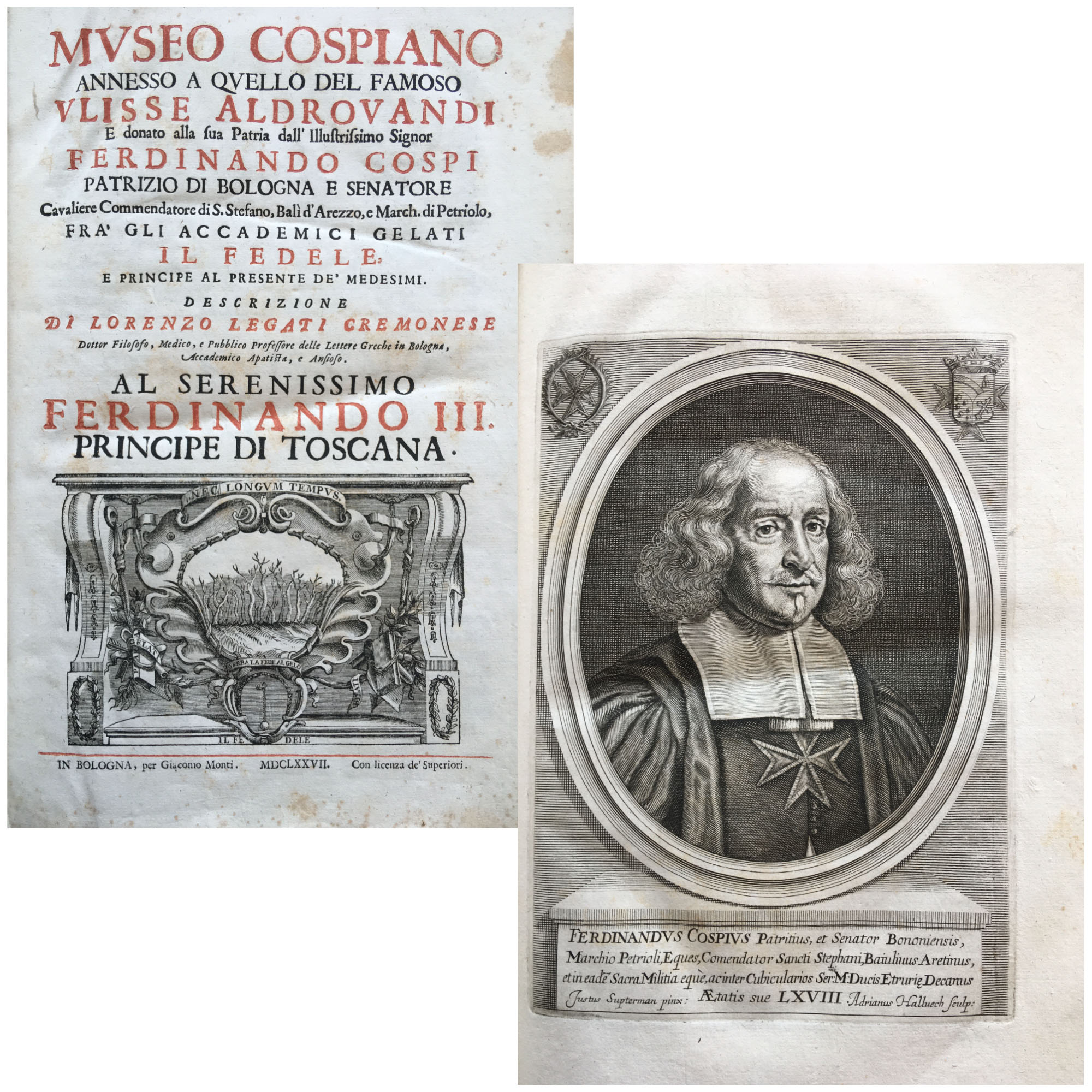
Description: LEGATI, Lorenzo (1677), Museo Cospiano annesso a quello del famoso Ulisse Aldrovandie donato all sua Patria dall'Illustrissimo Signor Ferdinando Cospi ptrizio di Bologna e Senatore... Bologna: Giacomo Monti. Titlepage printed in red and black with a woodcut device, large folding engraved plate of the interior of the museum (by Giuseppe Maria Mitelli), engraved portrait of Cospi (by Adrian Haelvegh after Justus Susterman), a woodcut portrait of the dedicatee, Ferdinand III of Tuscany, on dedication leaf, 532 pp. with woodcut illustrations in the text. Folio (320 x 215mm). Eighteenth century vellum; approximately 30 leaves toned, occasional spotting. With one photograph and two manuscript sheets tipped in, one text in Italian and one in French about the pictured medieval crossbow - The woodcuts represent various kinds of animals, terra cottas, arms, stones, minerals. The volume is divided into five books. The first lists human and animal specimens, birds and monsters. The second covers reptiles, fish, corals, shells and fossils, minerals, crustaceans, and plants. The third treats 'exotic' books and manuscripts, mathematical, scientific and nautical instruments, weapons, vases, funerary tablets and games. Book four describes medals and coins, while the last book classifies religious images from localities throughout the known world. It also describes the pre-Columbian Codex Cospi as a book of 'Mexican hieroglyphs, which are most extravagant figures and for the most part depict men and animals that are strangely monstrous'. Curios include an acephalous dog and cat with two bodies. There is also a section on games, a small (eight entries) but remarkable collection suite.
Select a thumbnail to view its caption.
.jpg)
Portrait of John Tradescant the Elder (by Hollar, 1656).
John Tradescant the Elder (c. 1570s-1638) was an English naturalist, gardener, collector, and traveller. Over the course of his life he visited many parts of the world, including the Low Countries, Arctic Russia, and the Levant. During these journeys he collected seeds, bulbs, and a remarkable variety of natural and artificial curiosities, assembling a celebrated collection of natural history and ethnographic objects. These were housed in his residence at Lambeth, London, which he called The Ark. The Ark became England's first museum open to the public, later known through the catalogue Musaeum Tradescantianum. Tradescant also acquired numerous specimens from English colonists in North America. From the family's botanical garden at Lambeth, on the south bank of the Thames, he and his son introduced many new plants into English gardens, several of which have since become established in horticulture.
John Tradescant the Younger (1608-1662), son of John Tradescant the Elder, was an English botanist, gardener, and collector. Following in his father's footsteps, he undertook collecting expeditions of his own, most notably to Virginia, enriching the family's cabinet of curiosities with numerous American specimens. In 1656 he published the catalogue of the collection under the title Musaeum Tradescantianum, describing its extraordinary holdings of books, coins, weapons, costumes, taxidermy, natural specimens, and other curiosities. The first edition was dedicated to the Royal College of Physicians, with whom he was negotiating the transfer of the family's botanical garden, while the second edition was dedicated to the recently restored Charles II. After his death, the library and museum passed to Elias Ashmole (1617-1692), forming the nucleus of the Ashmolean Museum, which opened in Oxford in 1683 and where much of the Tradescant collection is still preserved today.
- HEWETT, John (1980), The Tradescant Collection 1656 Facsimile [in coll.: Hardback book, as issued]
The Rare Portrait of John Tradescant the Elder by Engraver Hollar, from a Famous Engraving Collection
_front.jpg)
_back.jpg)
Portrait of John Tradescant the Elder
Engraving by Wenceslaus Hollar, 1656
Description: 1656 engraving of John Tradescant the Elder by Wenceslaus Hollar for Musaeum Tradescantianum. Set in old laid paper; inscription on the back in pencil which reads "Tradescant, Rare Print by Hollar, from the Julian Marshall Collection". Dimensions: TBD (sheet), TBD (print) - A rare engraving but well-known portrait of Tradescant for being the frontispiece of the collection catalogue Musaeum Tradescantianum : or a Collection of Rarities preserved at South-Lambeth neer London. Wenceslaus Hollar (1607-1677) was a prolific and accomplished Bohemian graphic artist of the 17th century who spent much of his life in England. Hollar's work was especially admired by Edward Harley, 2nd Earl of Oxford, and by his daughter, Margaret Cavendish Bentinck, Duchess of Portland, of whom Horace Walpole wrote: "Prints of Hollar, to complete his work, she bought at any price" (Walpole, 1936:6).
Provenance: Julian Marshall • Winfield Robbins - Julian Marshall had a very famous collection of various works on paper sold by Sothebys in 1864. Winfield Robbins (1840-1910) of Arlington, Massachusetts, had his collection donated to local institutions after his death where it remained for more than a century. Since this engraving is not listed with other Hollar engravings in the Sotheby's catalogue of 1864, it is likely that Robbins bought it directly from Marshall.
Select a thumbnail to view its caption.
COMING LATER